Getting involved in research can feel unnecessarily difficult when you are a medical student. Opportunities seem to appear through private networks, senior students already know the right supervisors, and the advice you receive is often limited to “email a consultant and see what happens”.
The reality is more encouraging: there are meaningful research opportunities for medical students, including for people without previous publications, advanced statistical skills or an established academic network. The key is knowing where to look and how to demonstrate that you will be useful to a research team.
Why research opportunities are difficult to access
Research teams do not always advertise their projects clearly. A consultant may have an idea but lack time to supervise someone new. A registrar may need help with screening papers, collecting audit data or preparing a conference abstract, but only mention the opportunity within their existing department.
This means access often depends on proximity, confidence and personal introductions rather than genuine interest or potential. Students from less research-intensive institutions, those without academic contacts and people balancing work or caring responsibilities can be particularly disadvantaged.
The solution is to use several routes at once while presenting yourself as someone who can make a practical contribution.
Start inside your own university
Begin with your medical school’s research office, student-selected components, intercalated degree opportunities, academic societies and departmental webpages. Many universities maintain mailing lists or internal project directories that are easy to miss unless you actively ask.
Speak to:
- Academic tutors and personal supervisors.
- Lecturers who teach subjects you genuinely enjoy.
- Clinical academics attached to your medical school.
- Research-active foundation doctors and specialty trainees.
- Student societies focused on surgery, medicine or research.
Ask whether there are ongoing projects needing defined contributions, rather than simply asking if “any research” is available.
Contact lecturers and clinical academics
A lecturer who teaches a subject well may also supervise projects, lead a research group or know colleagues looking for help. Before approaching them, spend a few minutes understanding their current work.
Look at their departmental biography, recent publications and declared research interests. Then explain why their work interests you and what you could realistically contribute. A thoughtful message to five suitable people is more effective than a generic email copied to fifty consultants.
Use PubMed to identify active research teams
PubMed is useful for more than reading papers. Its author searches and advanced-search tools can help you identify clinicians publishing in your chosen specialty and find teams that have recently produced research.
For example, if you are interested in plastic and reconstructive surgery, search for a focused topic such as “hand surgery nerve regeneration” or “breast reconstruction patient reported outcomes”. Review recent papers, identify the corresponding or senior authors, and note the hospitals or universities involved.
An active research group is more likely to have an existing workflow, ongoing studies and realistic opportunities to contribute than a department with no recent academic output.
Approach clinicians publishing in your chosen specialty
If you already know which specialty interests you, be specific. Orthopaedics, cardiology, dermatology, emergency medicine and plastic surgery all include research opportunities beyond laboratory science.
Projects may involve clinical audits, service evaluations, systematic reviews, retrospective datasets, educational research, surveys, case series or quality-improvement work. Each has different supervision, governance and methodological requirements.
You do not need to pretend to be an expert. Explain your stage of training, what you are interested in, the time you can commit and the skills you are willing to develop.
Join research societies and collaborative networks
Student research societies and specialty-interest groups often share opportunities, run introductory teaching sessions and connect students with more experienced researchers.
National trainee collaboratives can also involve medical students in multicentre data collection or coordinated research projects, depending on the particular study’s eligibility criteria and supervision arrangements.
Before joining, clarify what the project involves, who is supervising it, what approvals apply and how contributions will be recognised.
Make conferences work for you
You do not need to present a paper before attending a conference. Student-friendly meetings, specialty events and university research days can introduce you to people who are actively working on questions that interest you.
Prepare one sentence about your interests and one sentence about how you could contribute. After an interesting talk, ask a relevant question or follow up with a short, professional message.
A conference conversation is not valuable because it gives you permission to ask for authorship. It is valuable because it can start a genuine working relationship.
Use online research platforms
Academic networking sites, university opportunity pages and online research communities can all help you discover people and projects outside your immediate institution.
However, a profile or list of publications does not necessarily tell you whether a team needs a medical student. Look for platforms that describe active opportunities, required roles and practical expectations.
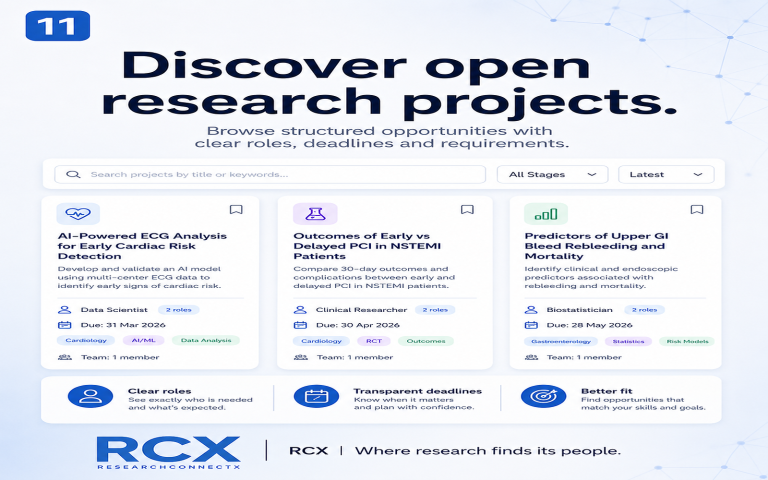
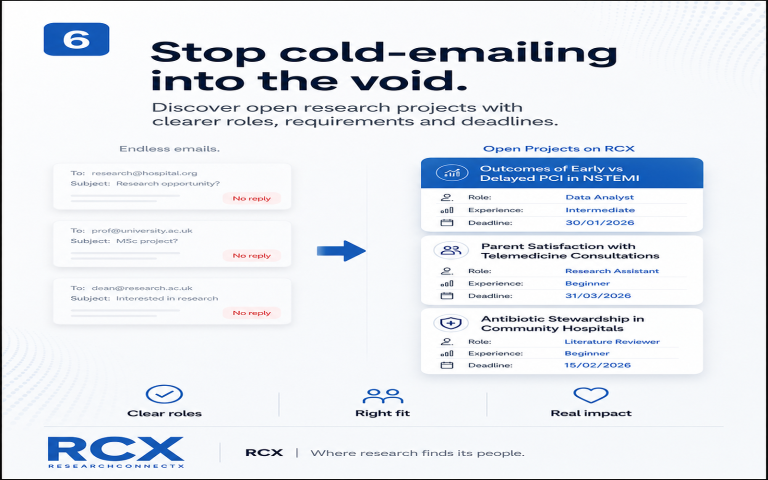
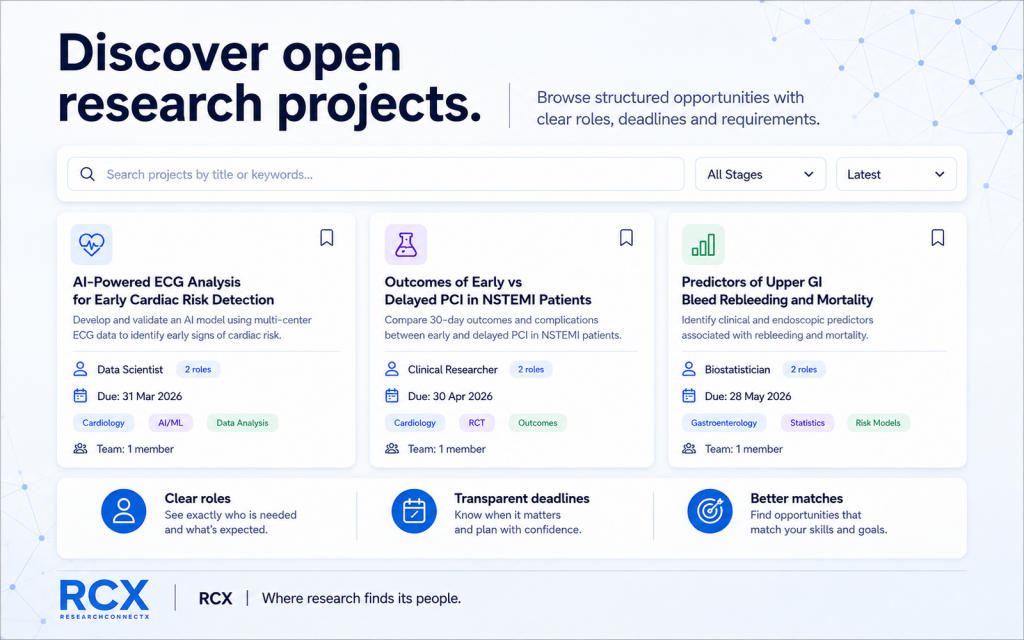
ResearchConnectX is designed to make research opportunities and potential collaborators easier to discover across institutions. Its open-project listings help connect researchers with active teams, while AI-assisted matching can surface opportunities aligned with a user’s interests, experience and skills.
How to use RCX open research projects
If you are looking for medical student research projects in the UK, start by creating a clear researcher profile. Include your university, clinical interests, relevant experience, practical skills and honest availability.
Then explore the live open research opportunities displayed by RCX. Assess each project for its subject area, available roles, expected deadlines and whether the work matches your current level of experience.
When contacting a project lead, explain why the topic interests you and identify one or two specific ways you could help. The goal is not to apply to every project. It is to find a team where your contribution is useful and your learning is properly supported.
Create your RCX profile and explore current opportunities.
How to be useful without previous publications
You do not need a publication record to contribute meaningfully. Many research teams need organised, reliable people who can learn a defined task and communicate clearly.
Depending on training, supervision and project approvals, useful contributions may include:
- Screening titles and abstracts for a systematic review.
- Extracting information from published studies.
- Helping develop or distribute an approved survey.
- Summarising relevant literature.
- Preparing a draft conference abstract.
- Supporting appropriately authorised data collection.
- Organising references and maintaining project records.
- Contributing to audit or quality-improvement work.
- Coordinating meetings, deadlines or follow-up tasks.
Be realistic about what you know. Reliability, curiosity and willingness to accept feedback are often more useful than claiming skills you cannot yet demonstrate.
Example first message to a principal investigator
Dear Dr Patel,
I am a fourth-year medical student with an interest in reconstructive surgery and clinical outcomes research. I recently read your paper on patient-reported outcomes following hand trauma and was interested in how your team approached functional assessment.
I would be keen to contribute to any suitable ongoing project, particularly literature screening, data extraction or manuscript preparation under supervision. I can commit approximately three hours per week and would be happy to provide a short CV or arrange a brief discussion.
Many thanks for considering my enquiry.
This message works because it shows genuine interest, demonstrates that the student understands the research area and offers realistic support without assuming a publication or authorship position.
Common mistakes medical students make
Sending generic messages
“I need research for my portfolio” does not explain why a research team should involve you. Personalise the message and show that you understand the project.
Overcommitting
Joining five projects is less valuable than contributing properly to one. Be honest about exams, placement commitments and availability.
Asking about authorship before understanding the work
It is appropriate to discuss how contributions will be recognised. However, authorship should be based on substantive contributions and the relevant journal or ICMJE criteria, not simply on being added to a team.
Ignoring approvals and confidentiality
Clinical research, audits and service evaluations may require different approvals, supervision and information-governance arrangements. Never access patient information unless you are authorised and the project has the appropriate oversight.
Waiting until you feel fully qualified
Most researchers develop their skills by contributing to supervised projects. You can learn literature searching, research methodology, reference management and basic data-handling as you progress.
A practical first-month plan
Week one: Choose a specialty or research theme, identify five active researchers and create a clear academic profile.
Week two: Read recent papers, contact suitable supervisors and explore open project listings.
Week three: Attend a society event, departmental research meeting or relevant conference session.
Week four: Choose a realistic opportunity, confirm supervision and agree your first defined contribution.
Starting research is less about having the perfect CV and more about making yourself visible to the right team.
Looking for your first project? Explore RCX or sign up to discover active research opportunities.
Related reading: Why junior researchers struggle to access opportunities and how smart-matchmaking connects early-career researchers with projects.
Frequently asked questions
Can medical students get involved in research without previous experience?
Yes. Many supervised projects involve introductory contributions such as literature screening, reference management, survey support, audit work and data extraction. The right opportunity depends on the project’s supervision, approvals and required skills.
Where can I find research opportunities for medical students in the UK?
Check your medical school, university research offices, clinical academic departments, specialty societies, trainee research collaboratives, conferences and research platforms advertising active projects.
Does every medical student research project lead to a publication?
No. Projects may lead to learning, presentations, audits, service improvements or publications, but outcomes cannot be guaranteed. Authorship should reflect genuine contribution and the relevant authorship criteria.