A good research supervisor can help turn an uncertain interest into a feasible project, strengthen your methods, open access to a research team and provide the feedback needed to finish the work. A poor match can leave even a promising project without direction, timely review or a realistic route to completion.
The challenge is not simply finding a senior academic whose profile contains the right keywords. You need someone whose recent work fits the question, whose team has the necessary resources and whose supervision style is compatible with your experience, timeline and goals.
The practical answer: define exactly what supervision you need, identify researchers through recent work and active projects, shortlist for scientific and working-style fit, send a concise personalised approach, and assess the opportunity before committing.
First decide what you are asking a supervisor to do
The phrase “I am looking for a research supervisor” can mean several very different things. Before contacting anyone, define the relationship you are seeking.
You may be looking for:
- supervision for an undergraduate dissertation or student-selected component;
- a defined role within an existing project;
- support to develop your own early research idea;
- a clinical academic mentor who can help you build experience over time;
- a doctoral supervisor for a PhD or DPhil proposal;
- a methodological supervisor in statistics, qualitative research, laboratory science or data science;
- a local principal investigator who can support governance, data access and delivery;
- a co-supervisor who complements expertise already present in the team.
These are not interchangeable requests. A professor may be an excellent doctoral supervisor but have no capacity for a short student project. A busy principal investigator may not provide frequent direct feedback, but a postdoctoral researcher or registrar within the same group may offer excellent day-to-day supervision.
A clear request makes it easier for the recipient to judge whether they can help, redirect you to someone more appropriate or offer a defined role.
Define your research direction before searching for names
You do not need a finished protocol, but you should be able to describe your direction in a few sentences. Write down:
- The field: for example, ophthalmology, public health, medical education or machine learning.
- The topic: the specific disease, intervention, population or problem that interests you.
- The type of work: laboratory, clinical, qualitative, systematic review, database analysis, survey, trial or implementation research.
- Your current level: what you already know and what training you still need.
- Your availability: the realistic hours, months and key deadlines you can commit.
- Your goal: experience, a dissertation, a presentation, a publication, doctoral training or a longer-term academic relationship.
This prevents a common mistake: contacting a large number of academics with a generic message that gives them no reason to believe the approach is relevant.
Where to find potential research supervisors
1. University and department profiles
Start with the departments, research institutes and centres working in your chosen area. Read more than the headline biography. Look for:
- current research themes;
- active grants and projects;
- recent publications;
- research methods used by the group;
- current students and team members;
- whether the page explicitly invites prospective students or collaborators;
- whether the supervisor is eligible for the programme or institution you are targeting.
For doctoral applications, always check the university’s formal process. Some programmes expect applicants to identify and contact a potential supervisor before applying; others allocate supervisors later or discourage informal commitments before central review.
2. Recent papers in your exact area
Search PubMed, Google Scholar or the main database for your field. Focus on papers from the last three to five years rather than relying only on famous older work.
Ask:
- Who is publishing repeatedly on the topic?
- Which groups use the methods you want to learn?
- Who appears as senior or corresponding author?
- Are there early-career researchers in the team who may supervise day-to-day work?
- Does the group publish work that progresses from abstracts to full papers?
Reading several recent papers also gives you the detail needed to write a credible approach. “I read your work on retinal disease” is weak. “Your recent study using single-cell analysis to examine Müller-glial responses is closely related to the question I want to develop” shows genuine fit.
3. Existing teaching and clinical networks
Lecturers, educational supervisors, consultants, research nurses, librarians and previous project leads can often direct you to active teams. A warm introduction is useful because it gives context, but it is not a substitute for preparation. You still need to understand the prospective supervisor’s work and make a clear request.
Do not restrict your search to the most senior person you know. An accessible researcher with active projects and a record of completing work may be a better first supervisor than a highly prominent academic with little capacity.
4. Conferences, seminars and research events
Attend departmental seminars, journal clubs, research showcases and conferences in your area. These settings allow you to understand what a group is currently doing and ask a specific question before following up.
A useful follow-up message should refer to the actual discussion. Avoid collecting names at an event and sending the same generic request to everyone afterwards.
5. Professional societies and research networks
Specialty societies, doctoral training networks, trainee collaboratives and methodological groups may advertise projects, mentoring schemes and supervisor directories. These routes are particularly valuable when your own institution has limited expertise in the topic.
6. Open research projects and collaboration platforms
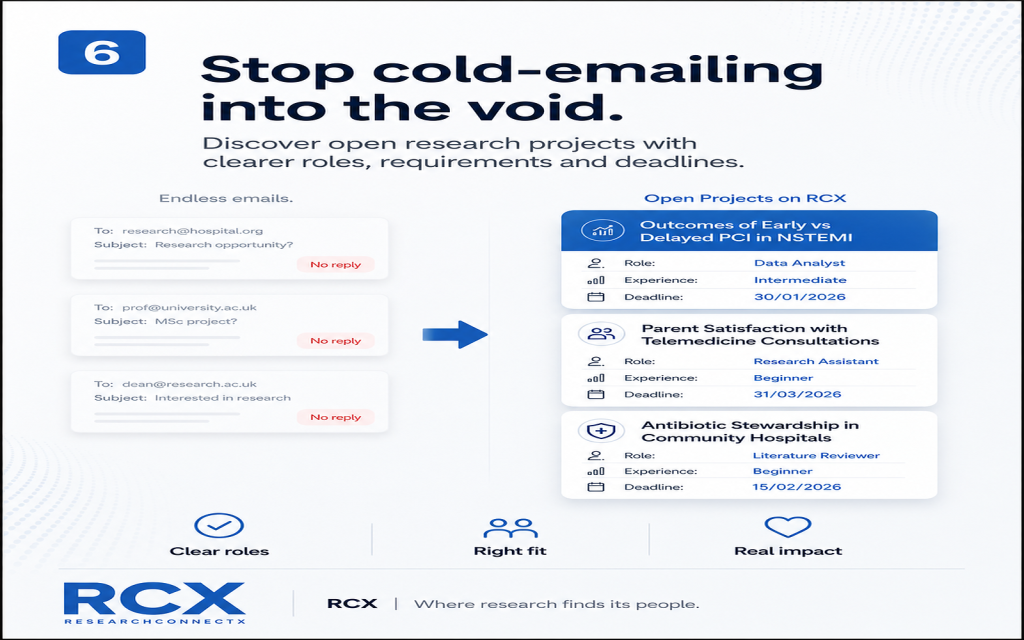
Traditional academic profiles show what someone has published, but they do not always show whether the person is currently seeking a student or collaborator. Open-project listings add a different signal: active intent.
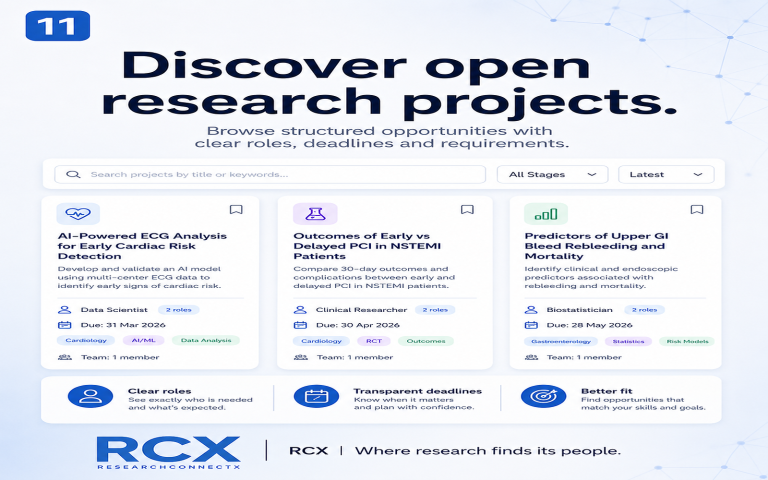
On RCX, researchers can explore open projects, view defined roles and discover people whose publications, methods, skills and interests align with their own. This does not remove the need to assess supervision quality, but it can reduce the time spent sending untargeted cold emails to researchers who have no suitable opening.
Build a shortlist based on fit, not status
Create a shortlist of approximately five to ten plausible supervisors rather than emailing dozens of people at once. For each person, record:
- topic overlap;
- methodological overlap;
- relevant recent publications;
- active projects or grants;
- location and institutional requirements;
- likely access to data, facilities or participants;
- team structure;
- signs of capacity to supervise;
- why you are specifically interested in working with them.
Then rank the shortlist across three dimensions.
Scientific fit
Does the supervisor have expertise directly relevant to the research question or methods? A broad specialty match may not be enough. Someone working in the same disease area using a completely different methodology may not be able to support the work you propose.
Project fit
Is there a realistic project, dataset, laboratory system or programme into which you could contribute? A supervisor’s interests may align with yours while no feasible project is available within your timeframe.
Supervision fit
Can the person or their team provide the level of guidance you need? Consider meeting frequency, access to day-to-day support, feedback times, expectations for independence and whether responsibilities are clearly delegated.
The best-known supervisor is not automatically the best supervisor for you. Prestige does not compensate for absent feedback, unclear ownership or a project that cannot be completed.
How to assess a supervisor before you approach them
Public information will never give a complete picture, but you can look for useful signals:
- recent and sustained publication activity rather than a profile built around old work;
- evidence that students and junior team members contribute to outputs;
- a lab or group page with named projects and people;
- clear descriptions of methods, resources and research priorities;
- completed theses or alumni progression where this is available;
- realistic project advertisements rather than vague promises;
- publications showing collaborative and multidisciplinary work.
For a major commitment such as a PhD, speak to current or former group members. Ask about the reality of feedback, availability, team culture, expectations, training and how problems are managed. Do not ask only whether the supervisor is “good”; ask specific behavioural questions.
How to write the first email to a potential research supervisor
Your message should be short enough to read quickly and specific enough to deserve a response. It should answer five questions:
- Who are you?
- Why are you contacting this person rather than anyone else?
- What research direction or opportunity are you interested in?
- What relevant experience or contribution do you bring?
- What exactly are you asking for next?
Example email structure
Subject: Prospective research project in [specific topic]
Dear Professor/Dr [Surname],
I am a [degree, training grade or role] at [institution] with an interest in [specific area]. I recently read your work on [specific paper or project], particularly [one genuine point of relevance].
I am looking for [a defined project / dissertation supervision / a doctoral supervisor] focused on [brief research direction]. My relevant experience includes [one or two directly relevant skills, projects or methods], and I can realistically commit [availability or timeframe].
I would be grateful to know whether you have a suitable current or planned project, or whether a member of your team may be appropriate to contact. I have attached a concise CV and would be happy to send a short project outline if useful.
Kind regards, [Name]
This template should be adapted. Copying it without the specific paper, project and request will produce another generic cold email.
What to attach – and what not to attach
For an initial approach, a concise academic CV is usually enough. Depending on the context, you may also include:
- a one-page research-interest statement;
- a brief project concept;
- an academic transcript when formally relevant;
- evidence of required funding or scholarship eligibility;
- a portfolio or GitHub link for computational work.
Do not send a large collection of certificates, a long unfocused proposal or a manuscript-sized attachment unless the supervisor or programme asks for it. Make the first decision easy: is there enough fit to justify a conversation?
When and how to follow up
Academics receive large volumes of email. A non-response does not necessarily mean rejection, but repeated messages within a few days are counterproductive.
A reasonable approach is to send one polite follow-up after approximately seven to ten working days. Keep it brief, restate the specific request and acknowledge that they may not have capacity. If there is still no response, move to the next suitable person rather than continuing indefinitely.
Do not send identical messages to multiple supervisors in the same department without considering the implications. If you are contacting more than one person, each approach should reflect a genuine and distinct fit.
Questions to ask at the first meeting
The meeting is not only an opportunity to impress the supervisor. It is also your opportunity to decide whether the project is credible.
Ask about:
- the exact research question and current stage;
- what work has already been completed;
- your proposed role and deliverables;
- the data, participants, laboratory resources or approvals required;
- who will supervise the work day to day;
- how often the team meets;
- expected feedback times;
- training you will need;
- realistic milestones;
- funding or costs;
- how authorship and contributor roles are discussed;
- what happens if the initial approach fails;
- the intended conference and publication route.
A serious supervisor should be able to discuss feasibility and uncertainty. Be cautious when the only promise is “this should be an easy publication.”
Red flags when choosing a research supervisor or project
Warning signs include:
- the project has no clear question or defined next step;
- you are promised authorship before any contribution is discussed;
- no one can explain whether approvals or data access are in place;
- the supervisor is unable to identify who will review your work;
- deadlines are imposed without considering your training or other commitments;
- previous students repeatedly report prolonged non-response or poor conduct;
- you are asked to collect or access data without appropriate governance;
- the project depends on resources that are not available;
- there is pressure to manipulate findings, conceal limitations or bypass ethical requirements;
- your role is described only as “help with everything.”
Every project contains uncertainty. The problem is not uncertainty itself; it is uncertainty without transparency, ownership or a plan.
How to become a stronger candidate for supervision
Supervisors are more likely to engage when you reduce the risk of taking you into the team. You do not need an extensive publication record, but you should demonstrate reliability.
Useful signals include:
- having read the group’s recent work;
- understanding the difference between your interests and a feasible project;
- being honest about your current skills;
- offering a realistic amount of time;
- responding promptly and completing small agreed tasks;
- learning the relevant method before asking to lead it;
- keeping organised notes and version-controlled files;
- accepting critical feedback without becoming passive;
- communicating early when a deadline is at risk.
For a first project, a well-defined contribution completed properly is more valuable than joining several vague projects that never reach an output.
How RCX can support supervisor and project discovery
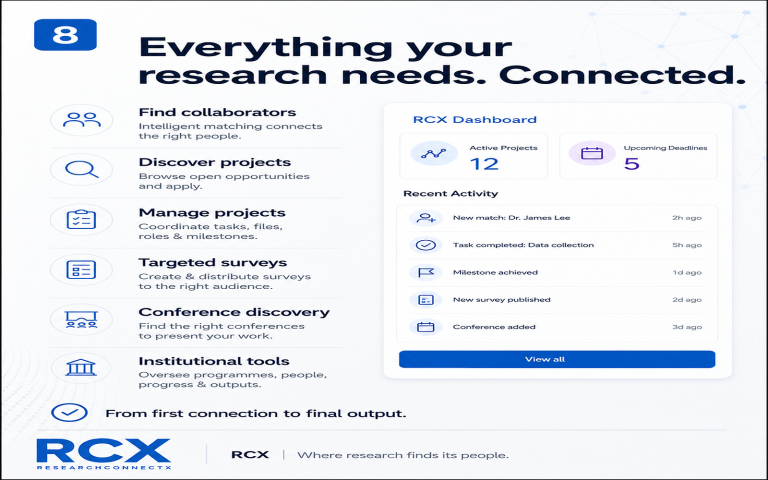
RCX is designed to connect researcher discovery with active research opportunities. A profile can make interests, methods, skills and experience easier to assess, while open projects can show the role a team is actually trying to fill.
A sensible workflow is:
- create a complete RCX profile;
- explore open projects in your field and adjacent disciplines;
- review the project question, role, requirements and deadline;
- assess the lead researcher and wider team;
- apply with a specific explanation of fit;
- use the project workspace to keep roles, tasks, files and milestones visible if the collaboration proceeds.
The platform can improve discovery and coordination. It cannot certify that every supervisor is the right mentor for every person. You should still conduct the same scientific, practical and interpersonal checks before committing.
Research supervisor checklist
Before approaching or accepting a supervisor, confirm that you can answer the following:
- What type of supervision or project am I seeking?
- What field, topic and method fit my interests?
- Why is this specific researcher relevant?
- Have I read at least two or three recent pieces of their work?
- Is there an active, feasible project or credible route to develop one?
- What can I contribute now, and what must I learn?
- How much time can I genuinely commit?
- Who will provide day-to-day supervision?
- Are roles, milestones and feedback expectations clear?
- Are the necessary data, facilities, funding and approvals available?
- Has authorship been discussed as a contribution-based process rather than promised?
- Have I considered the team culture and experiences of current researchers?
Frequently asked questions
How do I find a research supervisor with no previous research experience?
Start with a well-defined area of interest and look for structured projects that need a realistic entry-level contribution. Show that you have read the work, are willing to learn and can commit reliably. A small role completed well can lead to greater responsibility.
Should I contact a professor or a more junior researcher?
Contact the person who is scientifically and practically relevant. A professor may lead the programme, while a lecturer, postdoctoral researcher or senior trainee may provide closer supervision. In many strong teams, both strategic and day-to-day supervision are shared.
How many potential supervisors should I contact?
Build a focused shortlist rather than mass-emailing. Contact the strongest fit first or approach a small number with genuinely tailored messages. Programme rules may limit whether several prospective doctoral supervisors should be contacted simultaneously.
What should the subject line say?
Use a clear subject that identifies the purpose and topic, such as “Prospective MSc project in antimicrobial resistance” or “PhD supervision enquiry – retinal single-cell analysis.” Avoid vague lines such as “Research opportunity” alone.
What if a supervisor says they have no capacity?
Thank them and ask whether another member of the group or a related researcher may be appropriate. Capacity is a real constraint and is not a judgement on your potential.
Can RCX replace contacting supervisors directly?
No. RCX can help surface researchers and active opportunities, but a successful supervisory relationship still requires a clear discussion of fit, expectations, feasibility and governance.