Doctors often want to take part in research but do not know where credible opportunities are advertised, whom to approach or how to contribute alongside clinical work. The result is a familiar cycle: sending generic emails, joining loosely defined projects and waiting months for an output that may never materialise.
A better starting point is to choose the kind of research experience you need, identify a project with a clear question and active supervision, and agree a contribution that fits your skills and available time. Your first useful role does not have to be project leadership. Reliable delivery within a well-run team is usually a stronger foundation than collecting titles across several inactive studies.
The practical answer: define your goal, search through local research infrastructure, specialty networks, trainee collaboratives and open projects, assess feasibility and governance, then commit to one clearly owned contribution with milestones and supervision.
Why doctors should have access to research
Research is not limited to doctors in formal academic posts. Clinicians help identify important questions, recruit and care for participants, interpret findings in context, improve study delivery and translate evidence into practice. The General Medical Council has explicitly supported normalising research and promoting opportunities for doctors to engage with it.
The appropriate level of involvement will differ. One doctor may contribute to recruitment within an established clinical trial; another may lead a retrospective study, undertake a systematic review or enter a funded academic pathway. The objective is not for every doctor to become a full-time academic. It is for research participation to be accessible, responsible and proportionate to a doctor’s role and interests.
Start by defining what you want from research
Before looking for opportunities, decide what you are trying to achieve. Common goals include:
- learning how research is designed and governed;
- exploring whether an academic career is right for you;
- developing expertise in a chosen specialty;
- contributing to evidence that improves patient care;
- learning a method such as qualitative research, statistics or systematic review;
- presenting at a conference;
- producing a peer-reviewed publication;
- building experience for an academic training application;
- joining a long-term collaborative or research group;
- developing a question arising from clinical practice.
These goals require different projects. A short recruitment role in a well-run trial may provide excellent exposure to clinical research delivery but limited experience of analysis or writing. A systematic review may teach literature methods and manuscript development but no participant-facing research. Choose deliberately rather than assuming any project labelled “research” will meet every goal.
Seven practical routes into research as a doctor
1. Join an active project in your current department
Ask consultants, registrars, research nurses, pharmacists, allied health professionals and departmental academics about studies that are genuinely active. The most useful question is not “Do you have any research?” Ask instead:
- Which studies are currently recruiting or collecting data?
- Is there a defined task that needs an owner?
- Who supervises the work day to day?
- What approvals are already in place?
- What is the next milestone?
- Is there a planned abstract or manuscript?
Current clinical teams offer valuable context and access, but proximity alone does not guarantee quality. Assess the project as critically as you would an external opportunity.
2. Work with the local research and development team
Hospital research and development departments, clinical research facilities and research-delivery teams can explain which portfolio studies are open locally and how clinicians can support them. Opportunities may include:
- identifying potentially eligible participants;
- supporting informed-consent processes after appropriate training and delegation;
- undertaking study assessments;
- contributing to safety reporting or follow-up;
- helping improve recruitment pathways;
- attending investigator meetings;
- developing a sub-study or secondary analysis where permitted.
Clinical research delivery must follow the approved protocol, delegation arrangements, training requirements and local governance. Interest alone does not authorise a doctor to access study data or perform research procedures.
3. Join a trainee research collaborative
Trainee collaboratives allow clinicians across several centres to contribute to larger studies, audits and trials. They can provide a structured introduction to multicentre working and may offer local lead, data collection, analysis or writing roles.
Evaluate the collaborative’s track record. Look for completed outputs, transparent contributor policies, credible governance, central support and clear expectations. A project with hundreds of names but no defined responsibilities may provide less learning than a smaller collaboration where your role is visible and supervised.
4. Use specialty societies and research networks
Royal colleges, specialty associations, subspecialty groups, clinical study groups and early-career networks may advertise grants, fellowships, mentoring, research calls and collaborative projects. Attend research sessions at specialty meetings and review the society’s newsletters and working groups.
Do not contact a research lead only to ask for “anything available.” Refer to a specific theme, project or method and explain the contribution you could make.
5. Approach universities, biomedical research centres and academic departments
Search the research themes of nearby universities, National Institute for Health and Care Research infrastructure, clinical trials units and university-hospital partnerships. Look for investigators whose current work overlaps with the clinical problems you see.
A targeted approach is more effective than emailing an entire department. Read recent papers, identify the current programme and ask about a specific route to contribute. Where possible, seek a role that can be maintained through rotations or changes in hospital.
6. Apply for a formal clinical academic pathway
Depending on country and career stage, formal opportunities may include academic foundation posts, academic clinical fellowships, research fellowships, higher degrees, clinician-scientist programmes and funded doctoral training.
These pathways provide protected time and structured supervision, but they are not the only route into research. Before committing to a degree, test your interest through meaningful project work and speak to current trainees about the balance of clinical duties, research expectations, funding and future progression.
7. Explore open research projects across institutions
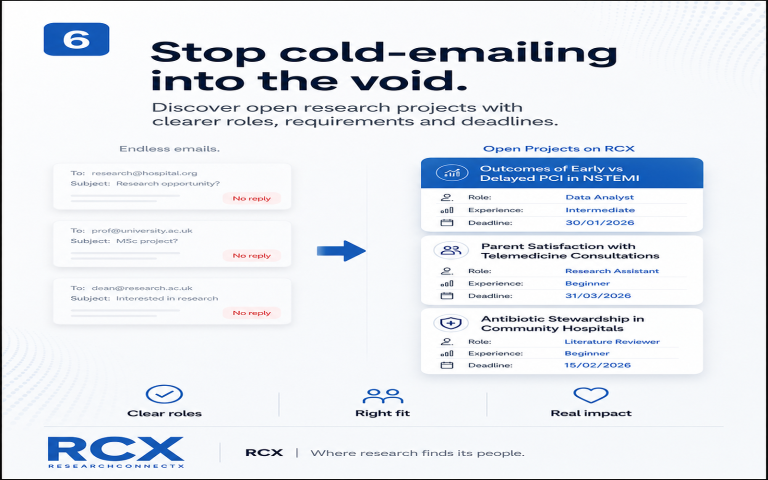
Many opportunities remain trapped within local email chains and personal networks. Open-project platforms can make the question, team, required role and deadline visible to doctors outside the host institution.
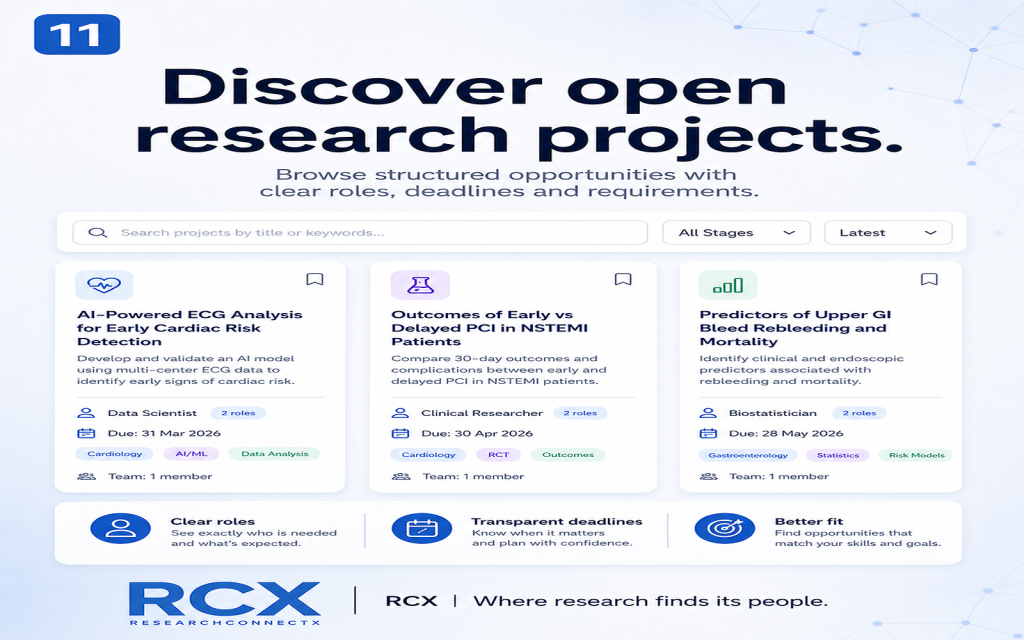
RCX allows researchers to explore active projects and potential collaborators across a wider network. A doctor can use a profile to show specialty interests, publications, methods and practical skills, then apply to a defined role rather than relying only on untargeted approaches.
Cross-institutional work requires extra clarity around supervision, contracts, data access, approvals and accountability. Online discovery does not remove institutional governance.
Choose a role that matches your current skills
Doctors can contribute to research in many ways. Possible roles include:
- literature searching and evidence synthesis;
- protocol development;
- participant identification and recruitment;
- clinical assessment or intervention delivery;
- data collection and validation;
- database design and data management;
- qualitative interviewing;
- laboratory work;
- statistical analysis or programming;
- figure and table preparation;
- manuscript drafting and critical revision;
- project coordination;
- patient and public involvement;
- conference abstract and presentation development;
- knowledge translation and implementation.
Be specific about what you can already do and what requires training. Clinical expertise is valuable, but it does not automatically confer competence in research methods, data protection, statistics or qualitative analysis.
A strong first contribution is bounded, necessary and assessable. Examples include completing a validated screening log for one site, performing a reproducible literature search, drafting a defined methods section or cleaning a documented subset of data. “Helping with the whole project” is not a role.
Understand whether the activity is research, audit, service evaluation or quality improvement
Doctors sometimes label every data project “research.” In the UK, research, audit, service evaluation and quality improvement may follow different governance routes. The classification depends on the purpose, design and context, not on what the team would prefer to call it.
Before collecting or accessing data:
- use the relevant institutional and Health Research Authority decision resources;
- discuss the project with the local research and development or clinical-governance team;
- confirm ethics, HRA, sponsor, information-governance and local capacity requirements as applicable;
- document the decision;
- do not assume that retrospective data use is automatically exempt;
- do not redesign an audit primarily to produce generalisable research without reconsidering approvals.
A publication goal does not determine the classification. Equally, an activity may be publishable even when it is correctly governed as audit or service evaluation, subject to journal and institutional requirements.
How to approach a principal investigator or research lead
A useful first message is concise and specific. It should show that you understand the work and are offering a credible contribution.
Example approach
Subject: Doctor interested in contributing to [specific project or research theme]
Dear Professor/Dr [Surname],
I am a [training grade/role] working in [department and institution] with an interest in [specific field]. I read your recent work on [paper, study or programme], particularly [specific relevant point].
I am looking to contribute to a well-defined project in [topic/method]. My relevant experience includes [one or two skills], and I can commit approximately [realistic availability] over [timeframe]. I would be particularly interested in supporting [specific task or type of role].
Please could you let me know whether your team has an active project requiring this contribution, or whether there is another colleague or study I should approach? I have attached a concise CV.
Kind regards, [Name]
Avoid overstating experience or promising time you do not have. A precise, honest offer is easier to place within a team than a broad request for “a publication opportunity.”
Assess the project before joining
Ask for enough information to judge whether the opportunity is real and feasible.
The research question
Can the team state the primary question clearly? If the project is still exploratory, can they explain the decisions that must be made next?
The current stage
Is the project an idea, an approved protocol, an active study, a complete dataset or a manuscript in preparation? Your role and chance of meaningful learning will differ at each stage.
Governance and data access
Who is the sponsor or responsible institution? Which approvals are in place? Are you permitted to access the data and work across organisational boundaries?
Your exact role
What deliverable will you own? Who will review it? What training is required? How does your work connect to the primary objective?
Supervision
Who provides day-to-day support, how often will you meet and what is the expected feedback time? A famous principal investigator may not be your operational supervisor.
Feasibility
Are the participants, dataset, funding, software and methods expertise available? Is the deadline compatible with the current stage?
Authorship and contributor recognition
Discuss authorship principles early, using recognised criteria and recorded contributor roles. Do not accept a guaranteed author position in exchange for a trivial task, and do not undertake substantial intellectual work on the assumption that recognition will be decided later.
Intended output
Is there a realistic conference or journal plan? Who owns the abstract, manuscript and response to reviewers? A project can finish data collection and still stall because no one owns the final output.
Build a credible first research contribution
Doctors with no publication history often believe they must lead a complex study to be taken seriously. That is usually the wrong first step. Build trust through delivery.
A strong early pattern is:
- agree one bounded task;
- clarify the standard and deadline;
- obtain required training and access;
- document your work so another person can verify it;
- communicate risks before the deadline;
- submit a complete first version;
- respond constructively to feedback;
- ask for the next level of responsibility only after delivering.
Over time, progress from data collection or screening into protocol development, analysis, writing, presenting and project leadership. The exact sequence varies, but responsibility should grow with competence.
Fit research around clinical work without letting either fail
Clinical rotas change, on-call work is unpredictable and rotations may move you away from the project team. Agree a working model at the beginning.
Set a realistic weekly commitment
Do not promise daily availability when you have no protected time. State what you can usually do and identify periods when exams, nights or rotations will reduce capacity.
Use milestone-based planning
“Work on the paper” is not a task. Better milestones include completing title-and-abstract screening, resolving 50 data queries, drafting one section or producing a checked analysis table.
Protect a regular research block where possible
Even one scheduled session each week is more reliable than hoping free time appears. If formal protected time exists, use it for the work that requires concentration rather than routine email.
Keep decisions and files centralised
Projects become fragile when key information is split across WhatsApp, personal inboxes, local drives and several versions of a spreadsheet. Use approved systems and a shared research workspace to record owners, files, decisions and deadlines.
Communicate early when circumstances change
A rota change, exam period or illness may affect delivery. Tell the project lead before the deadline and agree a revised plan or transfer of responsibility. Silence causes more damage than an honest constraint.
Red flags in research opportunities for doctors
Avoid or challenge projects where:
- the only advertised benefit is “easy authorship”;
- the question, protocol and next milestone are unclear;
- data collection has started without a defensible governance route;
- identifiable information is shared through unapproved channels;
- the team cannot explain who owns the data or project;
- you are asked to enter or analyse data without training or documentation;
- the same project has repeatedly changed hands without progress;
- dozens of contributors are recruited but responsibilities are undefined;
- authorship is allocated as payment for recruitment rather than contribution;
- the proposed deadline is incompatible with approvals, collection or analysis;
- negative or inconvenient findings are discouraged;
- there is no supervisor available to review the work;
- you are pressured to prioritise research over safe clinical care.
Research experience is not valuable merely because it appears on a CV. Poorly governed or scientifically weak work can waste time and harm participants, teams and credibility.
How RCX can help doctors find and run research projects
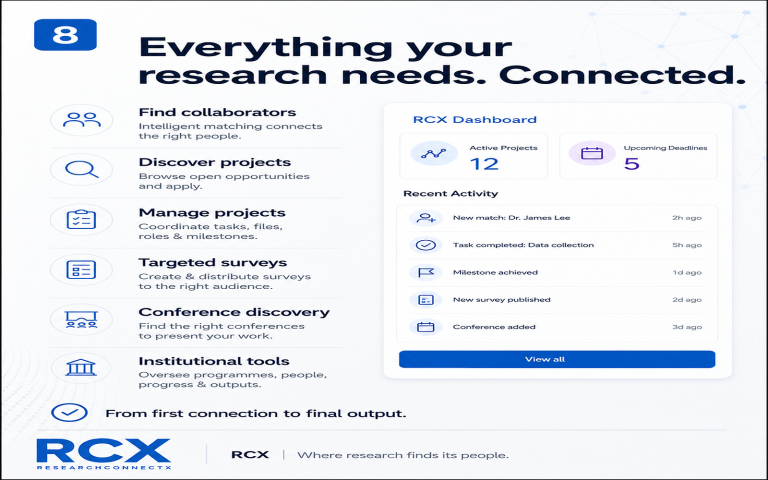
RCX connects several stages that are often separated:
- Researcher discovery: find people by publications, methods, skills and interests.
- Open projects: view active opportunities and the roles teams are seeking.
- Matching: identify projects and collaborators with relevant overlap.
- Project workspaces: coordinate tasks, owners, due dates, files and milestones.
- Survey tools: create and distribute surveys to appropriate matched groups where governance permits.
- Conference Radar: discover relevant presentation opportunities and deadlines.
For doctors, the value is not simply seeing more projects. It is seeing enough structure to judge whether a role fits your expertise, availability and career goal.
RCX should complement local research offices, sponsors, secure data platforms and specialist research tools. It does not replace ethics review, institutional approval, good clinical practice requirements or professional accountability.
Doctor’s research opportunity checklist
Before joining, confirm that:
- the project addresses a clear and worthwhile question;
- you know whether the activity is research, audit, service evaluation or quality improvement;
- the correct approvals and data permissions are documented;
- the principal investigator and day-to-day supervisor are identified;
- your role, deliverable and deadline are specific;
- the work fits your current skills or includes appropriate training;
- your clinical rota allows a realistic commitment;
- the team has the participants, data, funding and methodological expertise required;
- communication and file systems are agreed;
- authorship and contributor roles will follow recognised criteria;
- there is a credible conference, manuscript or implementation plan;
- you understand how to withdraw or hand over responsibly if circumstances change.
Frequently asked questions
How can I get involved in research as a doctor with no experience?
Begin with an active, supervised project and a defined entry-level contribution. Read the protocol, complete relevant training and deliver one bounded task reliably. Use that experience to move into methods, analysis, writing and leadership over time.
Where can NHS doctors find research opportunities?
Useful routes include departmental investigators, local research and development teams, clinical research facilities, trainee collaboratives, specialty societies, university partners, NIHR infrastructure and open research-project platforms such as RCX.
Does audit count as research experience?
Audit and quality improvement can develop valuable skills in question definition, data collection, analysis, teamwork and implementation, but they are not automatically research. Describe the activity accurately and follow the appropriate governance route.
Do I need an academic job to publish research?
No. Doctors in standard clinical posts can contribute to and lead publishable work when they have appropriate supervision, methods, approvals and access. Formal academic posts can provide protected time and infrastructure but are not the only route.
Should I join several projects at once?
Usually not at the beginning. One credible project completed well is more valuable than several inactive projects with unclear roles. Add commitments only when you have demonstrated that your existing work is manageable.
How do I know whether a project will lead to publication?
There is no guarantee. Assess the question, design, approvals, data access, supervision, methods expertise, team track record and manuscript ownership. Be cautious of anyone promising publication before the study is properly assessed.
Can RCX replace my hospital research and development department?
No. RCX can support discovery, matching and project coordination, but institutional research and development teams, sponsors and ethics or governance bodies remain responsible for the approvals and oversight within their remit.