A research project rarely moves in a perfectly straight line. Questions change after the literature search, methods change after feasibility checks, and manuscripts expose decisions that should have been recorded months earlier. That does not mean the research process should be improvised.
A defensible project has a clear sequence of decisions: define the problem, ask a precise question, choose an appropriate design, assemble the right team, obtain the necessary approvals, collect and analyse data reliably, and report the work transparently. The stages may overlap, but each one has a purpose and a quality gate.
The research process in one sentence: move from a meaningful problem to a focused question, a feasible protocol, an accountable team, approved and reproducible execution, transparent analysis, and responsible dissemination.
This guide explains the research process step by step and shows where projects most commonly lose momentum.
1. Start with the problem, not the proposed method
Weak projects often begin with a method looking for a question: “We have access to a database, so what can we publish from it?” or “We should run a survey because it is quick.” Access to data or a tool can create an opportunity, but it should not define the scientific purpose.
Begin by writing the problem in plain language:
- What is not known, not working or not adequately explained?
- Who is affected by that gap?
- What decision could better evidence improve?
- Why is the question worth answering now?
- What would change if the project produced a clear answer?
A useful problem statement is specific enough to guide the project but not so narrow that it predetermines the result. It should explain the gap without exaggerating novelty.
Quality gate
Do not proceed because the topic is interesting. Proceed when the team can explain the problem, the intended contribution and the group that will use the answer.
2. Turn the problem into a focused research question
The research question determines the design, data and analysis. It should identify the population or setting, the exposure or intervention where relevant, the comparison, and the outcome or phenomenon of interest.
Frameworks such as PICO can be useful for intervention questions, but not every study fits one template. Qualitative, diagnostic, prognostic, laboratory and methodological work require different structures. The principle is the same: remove ambiguity about what the study is trying to establish.
Test the question against five practical criteria:
- Clarity: would two readers interpret it in the same way?
- Importance: does the answer matter scientifically, clinically, educationally or operationally?
- Feasibility: can the required participants, data, expertise and time be obtained?
- Answerability: can the chosen design distinguish among plausible answers?
- Integrity: can the project be conducted ethically and reported honestly, including if the result is negative?
Write a primary question before adding secondary questions. Too many objectives create unfocused protocols, multiple-testing problems and manuscripts with no clear message.
3. Search the literature and map the evidence gap
A literature review is not simply a paragraph that proves the topic is important. It should establish what is already known, where the evidence is uncertain and how the proposed study differs from work already completed.
At minimum:
- define the concepts and search terms;
- search appropriate bibliographic databases;
- review recent systematic reviews and major guidelines;
- identify landmark and current primary studies;
- note active or registered studies where relevant;
- map disagreements, methodological weaknesses and missing populations;
- record the search date and enough detail to update it later.
For a formal systematic review, the search requires a reproducible protocol and usually specialist information support. For an original project, the initial review can be more targeted, but it still needs to be systematic enough to prevent avoidable duplication.
The literature may show that the original question is already answered, too broad or based on a false assumption. That is a successful outcome of early planning, not a failure.
Quality gate
The project should be able to state its intended contribution without relying on the phrase “no studies have ever…” unless that claim has been properly verified.
4. Choose the design that answers the question
The strongest design is not always the most complex design. It is the design that can answer the question with acceptable bias, precision, resources and ethical burden.
Possible approaches include:
- randomised or non-randomised interventional studies;
- prospective or retrospective observational studies;
- diagnostic or prognostic studies;
- qualitative interviews, focus groups or observations;
- mixed-methods studies;
- systematic, scoping or narrative reviews;
- laboratory or translational experiments;
- secondary analysis of existing datasets;
- surveys;
- implementation, service-evaluation, audit or quality-improvement work.
Do not label every organised data activity as research. In healthcare, research, clinical audit, service evaluation and quality improvement may follow different governance routes. Use the relevant institutional and national decision tools rather than choosing the label that appears easiest.
The design decision should address:
- source population and sampling;
- inclusion and exclusion criteria;
- exposure, intervention or index test;
- comparator where relevant;
- primary and secondary outcomes;
- follow-up period;
- major sources of bias and confounding;
- sample-size or information-power considerations;
- analysis approach;
- data availability and quality;
- participant and organisational burden.
5. Test feasibility before building the full project
A scientifically attractive idea can still be unworkable. Complete a feasibility review before investing heavily in a protocol.
Ask:
- Are enough eligible participants or records available?
- Can the main outcome be measured accurately?
- Is the recruitment window realistic?
- Does the team have the necessary methods and statistical expertise?
- Are equipment, software, laboratories or secure data environments available?
- Are permissions, contracts or data-sharing agreements likely to be achievable?
- Is there a budget for the work that cannot be delivered in kind?
- Can the project survive predictable staff turnover and clinical rota pressures?
- Is the output proportionate to the time and risk involved?
A pilot or small feasibility phase may be appropriate, but it should have defined objectives. “Let us collect some data and see what happens” is not a feasibility strategy.
6. Find the right collaborators and supervisor
Research rarely fails because no intelligent people were available. It fails because the project lacks a specific capability, the right people join too late, or no one has enough ownership to move the work forward.
Map the roles the project actually needs. These may include:
- principal investigator or accountable project lead;
- subject-matter expert;
- research supervisor or mentor;
- statistician, epidemiologist or methodologist;
- data manager or data scientist;
- laboratory or technical specialist;
- patient and public involvement contributors;
- site leads and participant-recruitment staff;
- project coordinator;
- writer, reviewer or dissemination lead.
Search for complementary expertise, not only senior titles. Review recent publications, methods, current projects and realistic availability. A famous researcher with no capacity may be less useful than an engaged specialist whose methods closely match the study.
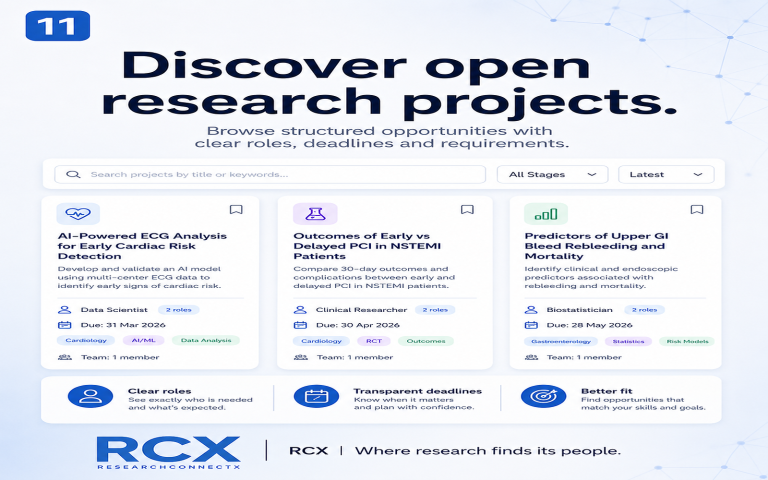
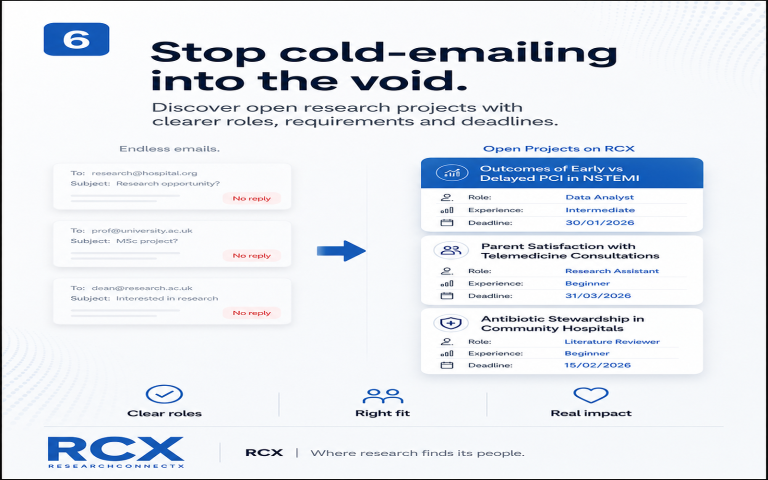
RCX supports this stage by connecting researcher profiles, publications, methods, skills, interests and active project needs. The platform can improve discovery, but the team must still assess scientific fit, availability and working expectations.
For detailed guidance, link here to How to Find Research Collaborators Online, How to Find a Research Supervisor and How to Find a Statistician for Your Research.
7. Agree roles, communication and authorship early
Do not wait until the manuscript is drafted to discuss contribution and credit.
Create a short team charter covering:
- project purpose and scope;
- named lead and decision-making route;
- each person’s responsibilities;
- expected time commitment;
- meeting and update frequency;
- file and communication systems;
- how disagreements will be resolved;
- confidentiality and data-access boundaries;
- likely outputs;
- authorship principles and contribution recording;
- what happens if a contributor becomes unavailable.
Authorship should be based on genuine contribution and accountability, not status alone. The ICMJE criteria are widely used in health research, while the CRediT taxonomy can make specific contributor roles more transparent. Neither should be treated as a substitute for an early conversation.
Authorship order may evolve as contributions evolve. Record changes and explain them rather than allowing assumptions to harden into conflict.
8. Write the protocol before collecting the data
The protocol is the operational and scientific blueprint. It should be detailed enough that the team can conduct the study consistently and that reviewers can understand why each decision was made.
A practical protocol usually includes:
- background and rationale;
- primary and secondary objectives;
- study design and setting;
- population and eligibility criteria;
- recruitment or record-identification process;
- intervention, exposure or data source;
- outcome definitions and measurement schedule;
- sample-size rationale;
- data-collection procedures;
- statistical or analytical plan;
- missing-data approach;
- safety monitoring where relevant;
- ethics, consent and confidentiality arrangements;
- data-management and retention plan;
- roles and oversight;
- timeline and milestones;
- dissemination plan;
- funding and conflicts of interest.
Version the protocol. When a method changes, record what changed, why it changed, who approved it and whether the change occurred before or after examination of the data.
Register where appropriate
Clinical trials, systematic reviews and some other study types may require or benefit from prospective registration. Use the registry appropriate to the design, jurisdiction and journal expectations. Registration does not repair a weak protocol; it makes the planned methods visible and reduces ambiguity about retrospective changes.
9. Determine ethics, governance and regulatory requirements
Ethical and governance review is not an administrative obstacle to be added after the scientific work. It is part of study design.
Requirements depend on the jurisdiction, participants, data, intervention and setting. In UK health and social care research, the Health Research Authority provides decision tools to help determine whether an activity is research and whether NHS Research Ethics Committee or HRA approval is required. Local research and development, information-governance and sponsorship processes may also apply.
Before data collection, confirm:
- the correct project classification;
- sponsor and institutional responsibilities;
- ethics-review requirements;
- consent requirements or lawful basis for data use;
- data-protection and confidentiality controls;
- site permissions;
- contracts and data-sharing agreements;
- insurance or indemnity where relevant;
- safety and adverse-event reporting;
- required registrations;
- training and delegation records.
Never assume that retrospective data, anonymised data or an online survey automatically requires no review. The correct route depends on how the data are obtained, linked, stored and used.
Quality gate
No participant recruitment, intervention or access to identifiable data should begin until the required approvals and permissions are documented.
10. Convert the protocol into a project plan
A protocol explains the study. A project plan explains how the team will deliver it.
Break the work into stages and milestones:
- protocol finalisation;
- approvals and contracts;
- database or survey build;
- site setup and team training;
- pilot testing;
- recruitment or data collection;
- data cleaning and quality control;
- analysis;
- abstract and manuscript drafting;
- conference and journal submission;
- close-out and archiving.
For each deliverable, assign one accountable owner, a due date, dependencies and a clear definition of completion. “The team will do the analysis” is not ownership. Name the person responsible for producing the analysis dataset, code, outputs and review.
Centralise tasks, files, milestones and decisions. Email, messaging applications and shared drives can support communication, but they should not become five competing versions of the project record.
RCX project workspaces are designed for tasks, owners, due dates, files and milestones within the research context. They should complement, not replace, approved electronic data-capture systems, laboratory notebooks, reference managers, statistical environments and institutional governance systems.
11. Design the data before collecting it
Data quality is created at the design stage, not rescued during analysis.
Prepare:
- a data dictionary with variable names, definitions, units and permissible values;
- standard operating procedures for measurements;
- case-report forms or survey logic;
- coding rules for missing, unknown and not-applicable values;
- unique participant or record identifiers;
- source-data and verification plans;
- access controls and audit trails;
- backup and retention arrangements;
- a process for queries and corrections.
Pilot the collection system with realistic examples. Check whether users interpret questions consistently, whether required variables are available, whether dates and units are unambiguous, and whether export formats support the planned analysis.
Do not collect variables merely because they might be interesting. Every field increases burden and creates another opportunity for missing or unreliable data.
12. Collect data consistently and monitor quality
During data collection, monitor the process rather than waiting until the end.
Track:
- recruitment or record-identification rates;
- eligibility and exclusion reasons;
- missingness in critical fields;
- protocol deviations;
- data-entry queries;
- site or assessor differences;
- adverse events where relevant;
- changes in staff, equipment or procedures;
- progress against milestones.
Hold short, regular reviews that lead to decisions. A meeting that simply reports that recruitment is slow is not management. Identify the cause, decide what is permitted within the protocol and approvals, assign an action and record the outcome.
If the project uses an online survey, test mobile usability, branching logic, duplicate-response controls, consent wording and export quality. RCX survey tools can support creation and targeted distribution, but sampling strategy and research governance remain scientific decisions.
13. Analyse according to a pre-specified plan
The analysis should answer the research question, reflect the design and acknowledge uncertainty.
Before running the final analysis:
- lock or clearly version the analysis dataset;
- preserve the raw data separately;
- document cleaning and derivation steps;
- check assumptions and data distributions;
- apply the planned approach to missing data;
- distinguish primary, secondary and exploratory analyses;
- control access to analysis code and outputs;
- record deviations from the protocol or analysis plan;
- use reproducible scripts where possible rather than undocumented manual steps.
A statistician should ideally be involved before data collection, especially where sample size, clustering, repeated measures, prediction modelling, causal inference or complex missingness matter. Bringing statistical expertise in only after the data are collected can reveal design problems that no analysis can repair.
Negative or inconclusive results are not failed results. The obligation is to report what the study can support, not to search repeatedly for a statistically attractive finding.
14. Start writing before the project is finished
The manuscript should not begin from a blank page after analysis. Draft the methods from the protocol, maintain the background literature and build empty tables or figure shells early.
A practical sequence is:
- confirm the target message and primary result;
- finalise tables and figures;
- write the methods accurately;
- write the results without interpretation;
- write the discussion around the principal findings, comparison with prior work, strengths, limitations and implications;
- refine the introduction so it leads directly to the question;
- write the abstract last;
- complete declarations, contributor roles, funding and data-availability statements.
Use the reporting guideline appropriate to the design. The EQUATOR Network maintains a searchable library covering many study types. Reporting guidelines do not replace good methods, but they reduce the risk that essential information is omitted from the manuscript.
Every statement in the results should be traceable to an analysis output, and every analysis should be traceable to documented data and code.
15. Present the work at the right conference
Conference presentation can occur before or after journal submission, depending on the project and relevant policies. It can provide valuable feedback, build visibility and identify collaborators for the next stage.
Choose a conference based on audience, scientific fit, legitimacy, timing and cost. Record abstract, funding and registration deadlines early. Link here to How to Find the Right Conference for Your Research for the complete process.
Do not let the presentation become the final destination. Decide in advance who will incorporate feedback and what deadline will move the project into manuscript submission.
16. Select a journal strategically
Choose a journal because the readership, scope and article type fit the work – not only because a metric is attractive.
Assess:
- whether the journal publishes the study design and topic;
- who needs to read the findings;
- indexing and discoverability;
- word, figure and supplementary-material limits;
- open-access options and charges;
- data, code and reporting policies;
- review timelines where stated;
- preprint and prior-conference policies;
- legitimacy, editorial board and publisher transparency.
Read several recent articles from the journal. Aims-and-scope text can be broad; the articles actually published show the editorial centre of gravity.
Prepare the manuscript for one target journal rather than submitting a generic version. Follow the instructions for authors precisely, but do not distort the scientific message to imitate a journal’s style.
17. Submit, respond to review and control versions
Before submission, complete a final integrity check:
- all authors meet the agreed criteria and approve the final manuscript;
- author order, affiliations and contributor roles are correct;
- data and analyses match the reported results;
- tables, figures and supplementary files are complete;
- ethics and registration details are accurate;
- funding and conflicts are declared;
- references support the statements made;
- the manuscript is not under incompatible simultaneous consideration elsewhere.
When peer-review comments arrive, respond systematically. Create a point-by-point document showing each comment, the response and the exact manuscript change. Where the team disagrees, explain the scientific reason respectfully and provide evidence.
Keep one controlled master manuscript. File names such as final_v7_reallyfinal.docx are a symptom of absent version control.
18. Publication is not the end of the workflow
After acceptance and publication:
- verify the final citation, DOI and author details;
- update ORCID and institutional profiles;
- deposit permitted versions in repositories;
- share data or code where appropriate and approved;
- create a plain-language summary;
- communicate findings to participants, services or policy audiences where relevant;
- record the output against the project and funding award;
- identify follow-on questions and collaborators;
- close and archive the project properly.
Dissemination should be proportionate and accurate. Avoid turning a cautious observational finding into a definitive social-media claim.
How RCX connects the research workflow
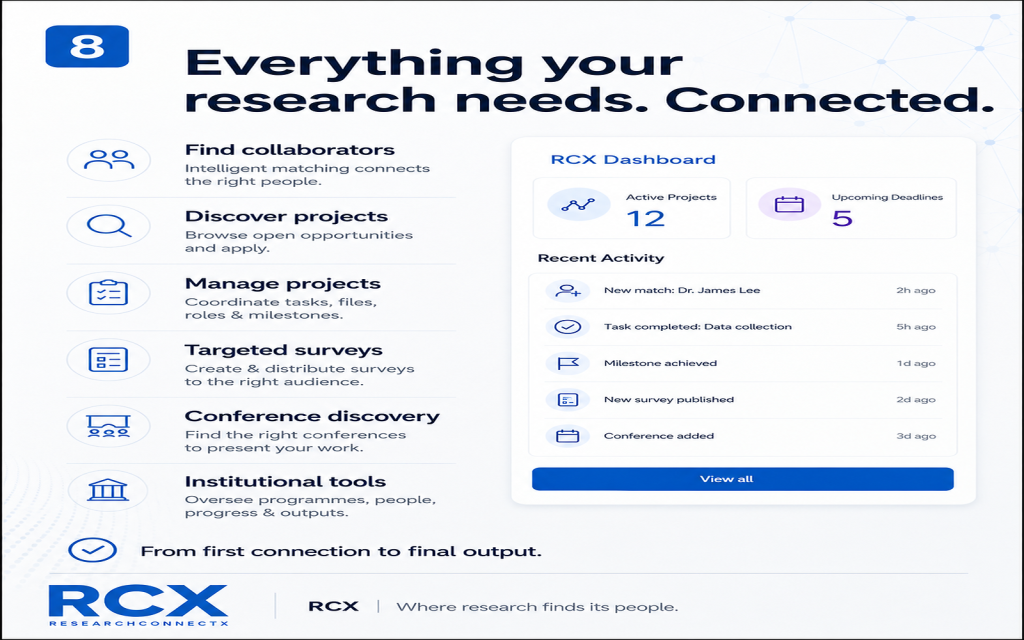
RCX is designed around the parts of research that are often fragmented across separate networks and systems:
- Discover: find open projects, researchers and opportunities.
- Match: identify collaborators whose skills, methods, interests and availability fit the need.
- Collaborate: bring the right people into a defined team.
- Manage: coordinate tasks, owners, files, milestones and communication in a research workspace.
- Collect: create and distribute targeted surveys where appropriate.
- Disseminate: surface relevant conferences, calls and other presentation opportunities.
- Oversee: give institutions visibility across people, projects, progress and outputs.
RCX is the collaboration and workflow layer. It should not be presented as a replacement for every specialist system. Reference management, manuscript authoring, electronic data capture, laboratory records, statistical analysis and institutional governance may still require dedicated tools.
The most common reasons research projects stall
Projects commonly lose momentum when:
- the question was never made precise;
- the design does not match the question;
- feasibility was assumed rather than tested;
- the statistician or methodologist joined too late;
- approvals were treated as an afterthought;
- no one owns the next deliverable;
- roles and authorship were left ambiguous;
- data definitions changed during collection;
- files and decisions are scattered across systems;
- meetings report problems but do not assign actions;
- the conference presentation is completed but the manuscript has no owner or deadline;
- the team is unwilling to pause or close an unviable project.
Good project management cannot rescue a scientifically weak study, but weak coordination can destroy a scientifically strong one.
Research project checklist: idea to publication
Before moving forward, confirm that the project has:
- a clear problem and primary research question;
- a literature-based rationale;
- an appropriate and feasible design;
- the required supervisor, collaborators and methods expertise;
- agreed roles, communication and authorship principles;
- a version-controlled protocol and analysis plan;
- documented ethics, governance and data permissions;
- a project plan with owners, milestones and dependencies;
- tested data-collection systems and a data dictionary;
- active quality monitoring;
- reproducible and transparent analysis;
- a reporting guideline and writing plan;
- a conference and journal strategy;
- controlled submission and revision files;
- a dissemination, archiving and project-close plan.
Frequently asked questions
What are the main stages of the research process?
The main stages are problem definition, research question, literature review, design, feasibility, team formation, protocol, approvals, project setup, data collection, analysis, writing, presentation, journal submission, publication and dissemination.
Do all research projects follow the same order?
No. Some stages overlap and projects may return to earlier decisions. However, data collection should not begin before the question, design, protocol and required approvals are sufficiently resolved.
When should I involve a statistician?
Ideally during question refinement and study design, before the sample size, outcomes, data structure and analysis plan are fixed. Late involvement may identify problems that cannot be corrected after data collection.
When should authorship be discussed?
At project initiation, then reviewed as contributions evolve. Use recognised authorship criteria and record contributor roles rather than promising authorship solely to secure participation.
Is a conference presentation the same as publication?
No. A conference abstract or presentation is an important research output but usually does not replace a full peer-reviewed manuscript. Check the policies of the conference and target journal.
What tools are needed to manage a research project?
Most teams need a combination of specialist tools: literature and reference management, approved data capture, analysis software, writing tools and a shared coordination system. RCX is positioned as the connected layer for people, projects, workspaces, surveys, opportunities and dissemination.