Many researchers look for a statistician only after data collection, when the spreadsheet is complete and the manuscript deadline is approaching. That is often too late. Statistical expertise can shape the research question, study design, outcome definitions, sample size, data structure and analysis plan long before anyone runs a model.
Finding the right statistician is also more precise than finding “someone who knows statistics.” A clinical trial, diagnostic-accuracy study, survival analysis, qualitative project and machine-learning model require different forms of expertise. The strongest collaboration begins by defining the methodological problem and matching it to a person with the right experience, capacity and working arrangement.
The practical answer: involve a statistician during study design, prepare a concise project brief, search through institutional and professional routes, assess method-specific fit, and agree scope, data governance, timelines, payment and contributor recognition before the analysis starts.
When should you involve a statistician?
Ideally, statistical input begins while the research question and protocol can still change. Early involvement can help the team decide:
- whether the design can answer the primary question;
- which outcome should be primary;
- how variables will be defined and measured;
- what comparison groups are required;
- whether clustering, repeated measures or missing data are likely;
- how large a study may need to be;
- how randomisation or sampling should work;
- which data fields must be collected;
- what the main analysis and sensitivity analyses should be;
- how the result can be interpreted without overstating it.
A statistician cannot repair every design problem after collection. If an important confounder was never measured, a sample is fundamentally biased or the outcome definition changed repeatedly, more sophisticated modelling may only make a weak study look complicated.
For grant applications, protocols, trials and studies with substantial methodological uncertainty, statistical collaboration should therefore begin before recruitment or data extraction. For a simple descriptive audit or exploratory student project, a shorter consultation may be sufficient – but the need should still be assessed at the start.
Do you need a statistician, biostatistician, data analyst or data scientist?
These titles overlap, and individuals may work across several areas. The useful question is not which title sounds most impressive; it is which expertise the project requires.
Statistician or biostatistician
A statistician develops or applies methods for study design, estimation, uncertainty and inference. A biostatistician applies these principles in health, medicine, biology and related fields. They may support sample-size planning, trial design, regression, longitudinal analysis, survival analysis, diagnostic studies, missing-data methods and statistical reporting.
Data analyst
A data analyst may focus on data cleaning, transformation, descriptive analysis, dashboards and implementation of a defined analysis. Some analysts have advanced statistical expertise; others work primarily from a pre-specified plan. Confirm what methodological responsibility the role includes.
Data scientist or machine-learning researcher
A data scientist may be appropriate when the project involves large-scale data engineering, prediction, natural-language processing, imaging, machine learning or deployment. However, prediction performance is not the same as causal or clinical inference. Health-data projects may need both data-science and biostatistical expertise.
Epidemiologist
An epidemiologist can provide critical input into population selection, bias, confounding, causal questions, exposure and outcome definitions, and observational study design. Many epidemiologists also have strong statistical skills.
Qualitative or mixed-methods methodologist
Not every research question should be forced into a quantitative design. A project exploring experience, implementation or meaning may require qualitative or mixed-methods expertise rather than a statistician alone.
Health economist, psychometrician or other specialist
Economic evaluations, scale development, adaptive trials, Bayesian analyses and complex surveys may require narrower specialist skills. Define the problem before deciding whom to recruit.
Prepare a one-page statistical collaboration brief
Before approaching a statistician, create a concise summary. It does not need to contain a perfect analysis plan, but it should allow someone to understand the study and estimate the work.
Include:
- Research question and objective – preferably one primary question rather than a broad topic.
- Study design – trial, cohort, case-control, cross-sectional, diagnostic, laboratory, systematic review or other design.
- Population and setting – who or what will be studied and where the data come from.
- Primary and secondary outcomes – including measurement time points where relevant.
- Exposure, intervention or predictor variables.
- Expected sample size – and whether it is fixed, estimated or still open to planning.
- Data structure – repeated measures, multiple sites, clusters, linked datasets, images or text.
- Current stage – idea, grant, protocol, approvals, collection, cleaning or analysis.
- Key deadlines – funding call, ethics submission, abstract or manuscript.
- What you need – design advice, sample-size calculation, analysis plan, code, independent validation, interpretation or full collaboration.
- Available funding – including whether the work is expected to be paid, institutionally supported or collaborative.
- Governance constraints – sensitive data, secure environments, data-sharing limits and required approvals.
This brief exposes gaps early. If the team cannot state the primary outcome or explain where the data will come from, the immediate need may be protocol development rather than analysis.
Where to find a statistician for your research
1. Your university, hospital or research institute
Start locally. Universities may have statistics departments, methods hubs, clinical trials units, epidemiology groups, data-science institutes or consultation services. Hospitals and healthcare organisations may have research and development teams, biomedical research centres, clinical research facilities or academic partners.
Local statisticians may already understand the governance systems, data platforms and clinical context. Access arrangements vary: some services are free at an early advisory stage, some are funded through departments or grants, and others charge by time or project.
2. Clinical trials units and research support services
A registered clinical trials unit may support study design, trial management, data management and analysis, particularly for complex interventional research. In England, the NIHR Research Support Service provides advice for researchers developing funding applications and supports areas including research design, methods and delivery.
Do not approach a trials unit only days before a grant deadline. Meaningful collaboration requires enough time to refine the question, design and resources.
3. Professional statistical organisations
Professional bodies may offer directories of consultants or routes to identify specialist expertise. The Royal Statistical Society maintains a consultants directory. A directory is a starting point, not a guarantee of fit: assess the person’s field, methods, professional standing, availability and contractual arrangements.
4. Recent publications using the methods you need
Search for studies in your topic that use a similar design or analysis. Review the methods carefully, then identify the statistical or methodological contributors. Corresponding authors, institutional profiles and contributor statements may show who led the analysis.
This route is especially useful for specialised methods. A generic request for “help with regression” may miss that the project actually requires multilevel modelling, competing-risks analysis, causal inference or external validation.
5. Colleagues, supervisors and research networks
Ask experienced investigators who supported their previous studies and whether the collaboration was reliable. Referrals can reveal practical information about communication, turnaround and domain understanding.
Be cautious about relying on a person solely because they are “good with SPSS” or produced a p-value for another team. Software familiarity is not evidence that the design or interpretation will be defensible.
6. Research collaboration platforms
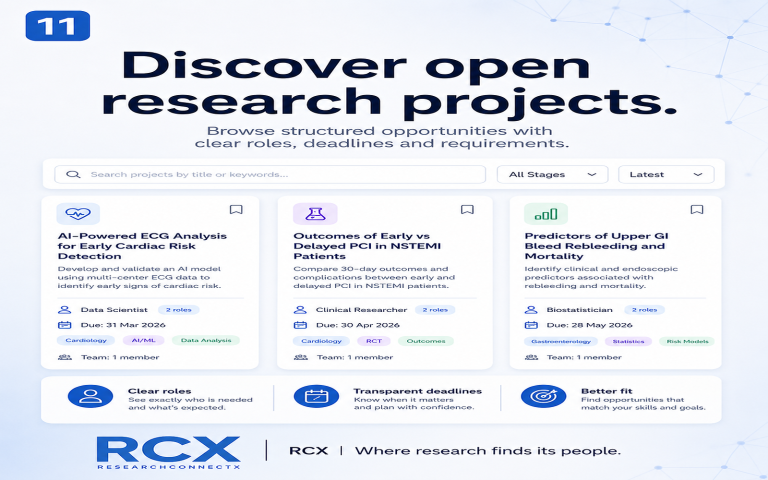
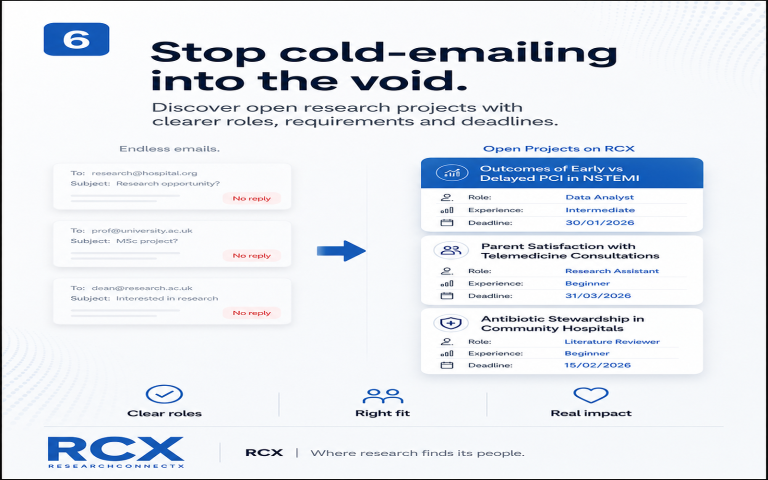
Academic profiles and publication databases can identify people who have used a method, but they do not always show whether those researchers are open to a new collaboration. RCX can support discovery by matching profiles around publications, methods, skills and interests and by connecting researchers to active projects with defined roles.
For a statistical role, the project description should still state the design, stage, expected contribution, access arrangements and deadline. Matching improves the shortlist; it does not replace methodological due diligence.
How to assess whether a statistician is the right fit
Methodological experience
Ask for examples of work with the design and methods you are considering. Topic familiarity is helpful, but method fit may be more important. Someone who understands longitudinal clinical data may adapt across disease areas more readily than someone with a broad healthcare label but no relevant analytical experience.
Stage of contribution
Clarify whether you need:
- a single advisory meeting;
- protocol and sample-size input;
- grant co-development;
- a full statistical analysis plan;
- data cleaning and coding;
- analysis and visualisation;
- reproducible code and documentation;
- interpretation and manuscript writing;
- responses to peer review;
- long-term co-investigator involvement.
The person who provides a short consultation may not be available to perform the final analysis. Confirm continuity rather than assuming it.
Domain understanding
The statistician does not need to be a clinician in your specialty, but they must understand the outcome, data-generating process and practical meaning of the variables. The research team must explain the clinical or scientific context rather than handing over an unexplained dataset.
Communication and teaching
A strong collaborator should be able to explain assumptions, uncertainty and limitations in language the wider team can understand. Equally, investigators must be willing to engage with the reasoning rather than asking only, “Is it significant?”
Capacity and timeline
Ask when the work can begin, what information is required and how revisions will be handled. Statistical work often expands when data quality problems emerge. Build time for cleaning, queries, sensitivity analyses and manuscript review.
Reproducibility
Agree what will be delivered:
- analysis-ready data specifications;
- code or syntax;
- package and software versions;
- output tables and figures;
- a data-cleaning log;
- a statistical report;
- a plain-language interpretation;
- documentation sufficient for another analyst to reproduce the result.
A collection of manually edited spreadsheet outputs is not an adequate reproducibility plan for a complex study.
Questions to ask in the first meeting
A focused first meeting should cover:
- What is the primary research question?
- Does the proposed design answer it?
- Is the primary outcome defined precisely?
- What effect or parameter is the study trying to estimate?
- What sample-size assumptions are required?
- How will missing data, clustering or repeated observations be handled?
- Which variables and time points must be collected?
- Are there major sources of bias or confounding?
- What analysis is primary, and which analyses are exploratory?
- What software and secure environment will be used?
- What data cleaning and validation are required?
- Who owns each deliverable?
- What is the timeline and estimated workload?
- How will the statistician contribute to the protocol, manuscript and peer-review response?
- What are the payment and authorship arrangements?
Do not treat this meeting as an attempt to extract a free analysis plan and then hand it to someone else. Be transparent about the intended relationship.
Agree scope, payment and authorship before work begins
Statistical contribution can range from paid consultation to substantial intellectual collaboration. These arrangements should be explicit.
Scope
Document the tasks, deliverables, number of meetings, expected revisions, deadlines and what is outside scope. State who is responsible for data cleaning, variable coding, analysis, figures, methods text and responses to reviewers.
Payment
Ask whether the statistician is funded through an institution, grant, departmental service or consultancy agreement. Include realistic statistical costs in grants. Do not assume a specialist will perform substantial work without funding merely because the project is academic.
Payment and authorship are different questions. Paying for legitimate professional work does not automatically exclude authorship, and lack of payment does not automatically justify authorship.
Authorship and contributor roles
Authorship should follow recognised criteria and reflect substantial intellectual contribution, participation in drafting or critical revision, approval of the final work and accountability. A statistician who shapes the design, conducts and interprets the analysis, and contributes to the manuscript may meet those criteria. A limited technical service may be more appropriately acknowledged.
Use the CRediT taxonomy to record roles such as methodology, formal analysis, software, visualisation and validation. Revisit the discussion as contributions evolve rather than promising a fixed author position before the work is known.
Protect data and respect governance
Before sharing any dataset, confirm:
- whether the recipient is authorised to access it;
- whether a data-sharing or processing agreement is required;
- where the data may be stored and analysed;
- whether direct identifiers have been removed where appropriate;
- whether the intended analysis is covered by the protocol and approvals;
- how access will be revoked and files archived;
- whether generated outputs could create a re-identification risk.
Never email identifiable participant data or upload it to an unapproved platform for convenience. The statistical workflow must operate within the project’s legal, ethical and institutional controls.
Red flags in a statistical collaboration
Be cautious when:
- the statistician is invited only to “make the results significant”;
- the primary outcome is changed after results are inspected without transparent reporting;
- dozens of tests are run with no plan for multiplicity or interpretation;
- assumptions and limitations are ignored;
- a collaborator recommends a method but cannot explain why it fits;
- there is no reproducible code or analysis record;
- results are copied manually between spreadsheets and documents without checks;
- the team asks for identifiable data before governance is resolved;
- the scope, cost or deadline remains deliberately vague;
- authorship is traded for a one-off calculation or withheld despite substantial intellectual work;
- the analyst is expected to infer the clinical meaning of poorly documented variables alone.
Statistical expertise should improve the integrity of the study, not provide a technical appearance of certainty.
How RCX can help identify methodological collaborators
RCX researcher matching is designed to consider more than a broad job title. Profiles can surface publications, methods, skills and interests, allowing a project lead to search for a collaborator whose experience matches the analytical problem.
A strong project listing for a statistician should include:
- the research question and design;
- the project stage;
- the methods likely to be required;
- the data source and governance status;
- the expected role and deliverables;
- the timeframe;
- whether funding is available;
- the proposed contributor and authorship discussion.
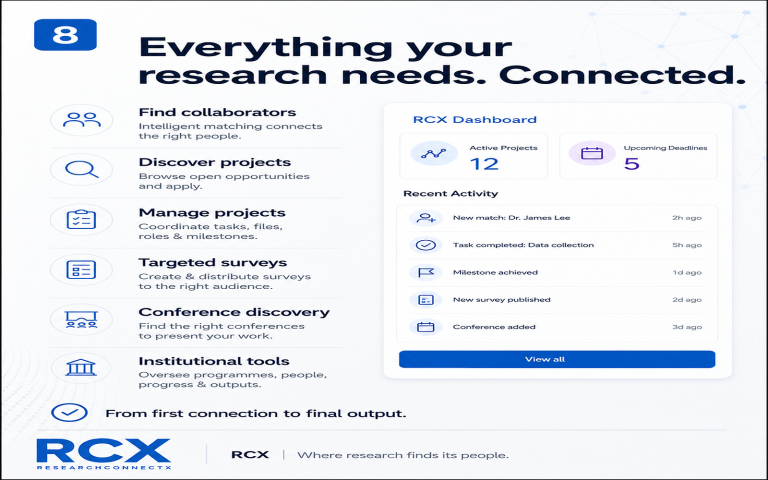
Once the team forms, a shared project workspace can keep the protocol, analysis plan, tasks, decisions, files and deadlines connected. Specialist analysis may still occur in approved statistical software or a secure data environment; RCX should be used as the collaboration and coordination layer, not as a substitute for those controls.
Statistician collaboration checklist
Before starting, confirm that:
- the primary question and outcome are clear;
- the design is appropriate and still open to necessary change;
- the required statistical methods have been identified at a sensible level;
- the statistician has relevant methodological experience;
- the expected sample size and assumptions have been reviewed;
- all essential variables and time points are included in data collection;
- the analysis plan distinguishes confirmatory and exploratory work;
- data access and secure working arrangements are approved;
- scope, costs, deadlines and revisions are documented;
- code, outputs and documentation will be reproducible;
- authorship and contributor roles are discussed using recognised criteria;
- enough time remains for data queries, interpretation and manuscript review.
Frequently asked questions
Do I need a statistician for every research project?
Not necessarily. The level of input depends on the question, design, risk and complexity. Even apparently simple studies can benefit from early methodological review, while complex trials or observational analyses usually require sustained statistical collaboration.
Can I contact a statistician after collecting the data?
Yes, but their options may be limited by decisions already made. Involve them as early as possible when the question, sample, outcomes and data structure can still be improved.
Is a data analyst the same as a statistician?
Not always. Roles and skills overlap, but a data analyst may focus on preparing and summarising data, whereas a statistician may take greater responsibility for design, inference and uncertainty. Assess the individual’s expertise rather than relying on the title.
Should a statistician be a co-author?
Authorship depends on the nature and extent of the contribution, not the job title. Substantial input into design, analysis, interpretation and manuscript development may meet authorship criteria. Limited technical assistance may warrant acknowledgement instead.
How much does a statistical consultant cost?
Costs vary by country, institution, experience, project complexity and whether support is funded through a university, research service or grant. Request a written scope and estimate. For funded research, budget for statistical input from the design stage rather than treating it as an unexpected final expense.
Can RCX guarantee the quality of a statistician?
No platform match should replace due diligence. RCX can help identify potentially relevant collaborators, but the project lead must verify qualifications, experience, availability, governance arrangements and fit.