The right research collaborator can turn a promising idea into a completed study, a stronger grant application or a publication with genuine impact. The difficulty is rarely a shortage of talented people. It is knowing who has the right expertise, who is actively looking for projects and how to approach them with a clear, credible proposal.
If you are trying to understand how to find research collaborators, the most effective approach combines established academic networks with tools that connect researchers to live opportunities. Here is how to do it well, whether you are a medical student, early-career researcher, principal investigator or member of an established research group.
Why finding research collaborators is still difficult
Research depends on teamwork, yet opportunities are often hidden inside departments, private messaging groups and professional networks. A clinician may need a statistician, a laboratory scientist may need access to clinical data, and a medical student may have time to contribute but no obvious route into an active team.
Traditional academic profiles show what someone has published. They do not always show whether that person is available, interested in a new project or looking for the particular skills you can offer. This makes discovery inefficient and gives an advantage to people who already know the right contacts.
The first step is to define what you actually need: subject expertise, methodological support, patient or dataset access, project coordination, writing capacity, institutional representation, or mentorship.
Traditional ways researchers find collaborators
ResearchGate and academic networking sites
ResearchGate can help you identify researchers working in your field, explore publications and follow emerging topics. It is particularly useful when you already know the subject area and want to understand who has contributed to it.
The limitation is that a strong publication record does not automatically tell you whether someone is recruiting collaborators. Use the platform to identify relevant people, then investigate their current projects and contact them with a specific reason for getting in touch.
LinkedIn and X
LinkedIn can be valuable for finding clinical academics, research groups, university departments and founders working at the intersection of research and technology. X may still be useful in some specialty communities, although engagement and professional norms vary considerably.
Search for your specialty, institution and methodology together. For example, try “plastic surgery systematic review”, “orthopaedic trauma outcomes research” or “clinical bioinformatics Oxford”. Follow people who share active opportunities, not only those with impressive job titles.
Conferences and research meetings
Conferences remain one of the best ways to have meaningful conversations with researchers outside your immediate network. Review the programme before attending, identify relevant speakers and poster presenters, and prepare a short introduction explaining your interests and contribution.
Following up within a few days matters. Refer to the specific presentation or discussion, suggest a realistic next step and avoid asking vaguely whether there are “any projects”.
PubMed and Google Scholar
PubMed’s author and advanced-search tools can help you identify active teams, recent publications, senior authors and institutions. Google Scholar offers another way to review publication histories and citation networks.
A practical search might combine a topic and institution, such as “hand transplantation sensory recovery Oxford”, then narrow results to recent years. Look for recurring author groups, recent methodological work and corresponding authors whose current interests match your own.
Universities, hospitals and research societies
Departmental research pages, university societies, student research groups and hospital audit meetings can reveal opportunities that never appear on social media. Speak to academic supervisors, specialist registrars, research nurses and junior doctors who are already involved in ongoing studies.
These local connections can be especially useful for projects that require institutional approvals, patient recruitment or access to existing datasets.
Dedicated research collaboration platforms
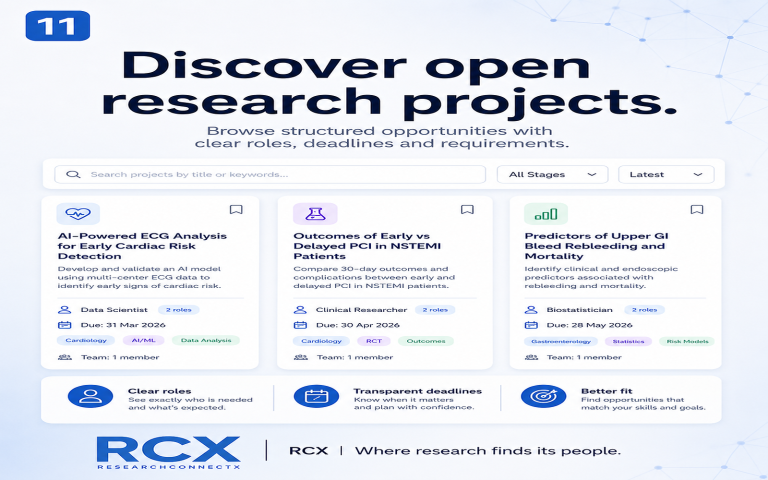
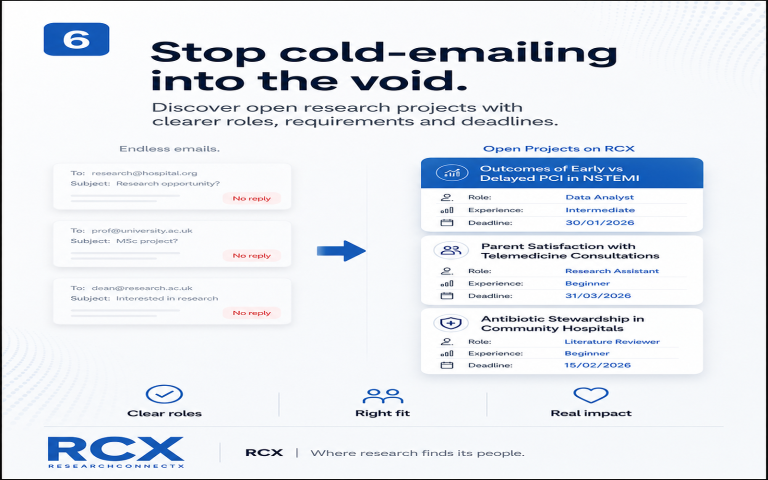
A dedicated research collaboration platform adds something traditional directories often lack: an explicit connection between people, available roles and active projects.
Instead of identifying an impressive researcher and guessing whether they are available, users can explore project opportunities, describe their own skills and find researchers who are interested in collaboration now.
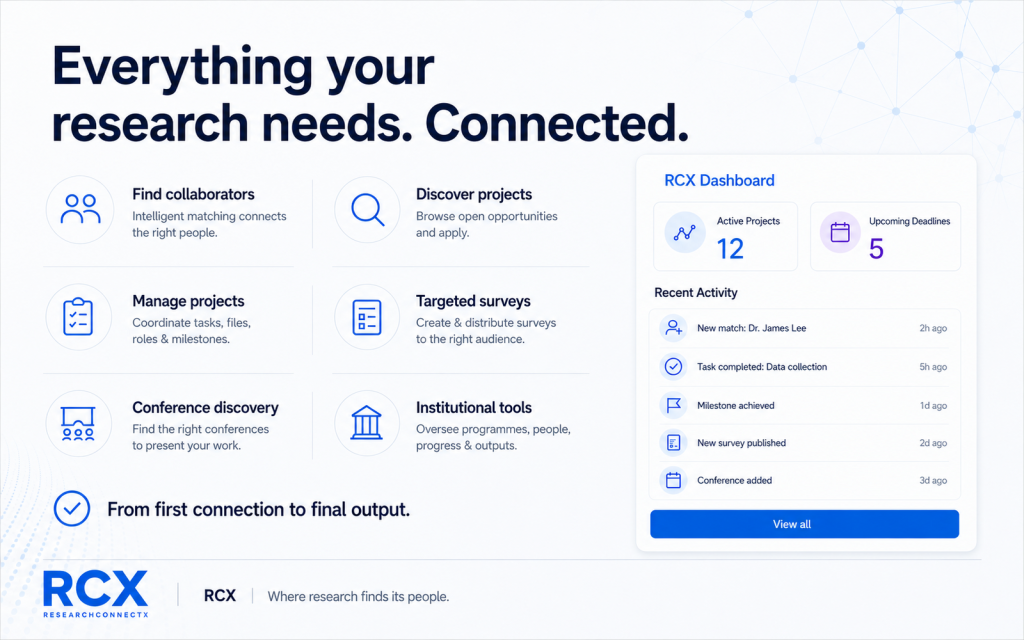
ResearchConnectX brings these stages together. Researchers can create profiles reflecting their interests, publications, methods and practical skills, discover open projects and connect with people whose expertise aligns with their goals.
Using AI to find research collaborators online
Manual keyword searches have a predictable weakness: they identify people who use the same words you do. Good collaboration often depends on complementary expertise rather than identical terminology.
A surgeon studying postoperative outcomes may benefit from a health economist, qualitative researcher or machine-learning specialist even when none of them uses the same headline keywords. AI-assisted discovery can surface potential relevance across research interests, previous publications, methodological experience and stated skills.
This does not replace judgement. It creates a more useful starting point by helping researchers find potential collaborators they might otherwise miss.
How RCX matching works
RCX positions collaboration around practical fit rather than visibility alone. Its platform can connect researchers using information such as:
Research interests and specialty areas.
Relevant publications and previous experience.
Methodological strengths and complementary skills.
Open project roles and opportunities.
Relevant conferences and dissemination opportunities.
The result is a clearer route from discovery to action: identify suitable people, explore active projects, communicate and manage the collaboration within a connected research environment. Match scores are recommendations, not a guarantee of quality or suitability, and researchers remain responsible for deciding whom to work with.
How to approach a potential research collaborator
A good first message answers four questions: who are you, why are you contacting this person, what is the project, and what contribution are you offering or requesting?
Try a concise message such as:
Hello Dr Ahmed, I am a foundation doctor with an interest in reconstructive surgery and outcomes research. I recently read your work on nerve recovery following upper-limb reconstruction and noticed an overlap with a review our team is developing. We would value methodological input on outcome selection, and I would be happy to share a short project summary if this is of interest.
Avoid generic messages, exaggerated claims and requests that create unnecessary work for the recipient. Specificity signals that you have done your homework.
How to assess whether a collaborator is the right fit
Research fit involves more than subject knowledge. Before committing, discuss the practical questions that determine whether the project can actually progress.
Does the person bring skills or experience the team genuinely needs?
Are they interested in the research question and intended output?
Do they have realistic availability for the proposed timeline?
Are data access, ethics and institutional requirements understood?
Is communication likely to be clear and reliable?
Are expectations around contribution and authorship compatible?
A short introductory call and a written project summary can prevent months of avoidable misunderstanding.
Agree authorship and expectations early
Authorship should reflect substantive contribution, not seniority, introductions or informal promises. The International Committee of Medical Journal Editors authorship recommendations set out four criteria covering contribution, drafting or critical revision, final approval and accountability.
Discuss expected roles, likely authorship arrangements, timelines and decision-making before major work begins. Revisit those conversations when contributions change. Nobody should be promised an authorship position without the opportunity to meet the relevant criteria.
Manage the collaboration after the match
Finding the right person is the beginning, not the endpoint. Successful teams need a shared understanding of what happens next.
Create one project overview, assign named task owners, agree milestones, keep key decisions accessible and review progress regularly. A structured RCX project workspace can help teams keep tasks, owners, due dates, files and milestones connected instead of spreading the project across email threads and messaging groups.
Your research-collaboration checklist
Define your research question and the skills you need.
Search existing networks, publications and institutional communities.
Explore dedicated platforms and live project opportunities.
Approach potential collaborators with a specific, respectful message.
Check availability, research fit, governance and communication expectations.
Agree roles, authorship principles and practical timelines early.
Use a shared workspace to keep the collaboration moving.
The best way to find researchers to collaborate with is not to send more speculative messages. It is to make research interests, opportunities and expectations visible to the right people.
Ready to find your next collaborator? Create your RCX profile and discover research opportunities designed around the people and skills your work needs.
Related reading: How research smart-matchmaking connects collaborators and why research projects need better coordination.