When researchers discuss artificial intelligence, the conversation often centres on writing assistants, literature summaries or automated analysis. Those applications can be useful, but they overlook another important challenge: finding the people who can help a research idea become a successful project.
AI research collaboration is about using intelligent tools to identify relevant researchers, surface suitable projects and connect complementary expertise across departments and institutions. It does not replace academic judgement or scientific relationships. It helps researchers spend less time searching blindly and more time building collaborations that make sense.
AI is not only a writing assistant
Research depends on more than producing text. A strong study may require clinical insight, statistics, qualitative methods, health economics, data science, patient involvement, project coordination and access to specialist facilities.
The difficulty is that these skills often sit in different departments, institutions or professional networks. Even when the right collaborator exists, the project lead may have no efficient way to find them.
An AI research platform can help by organising signals about research interests, experience and project needs, then suggesting people or opportunities that merit a closer look.
The researcher-discovery problem
Academic expertise is widely distributed but not always easy to interpret.
A researcher’s university profile may be out of date. A publication database can show previous papers but not current availability. A LinkedIn page may describe a job title without revealing methodological strengths. A private messaging group may include an excellent opportunity that never reaches the people who could contribute most.
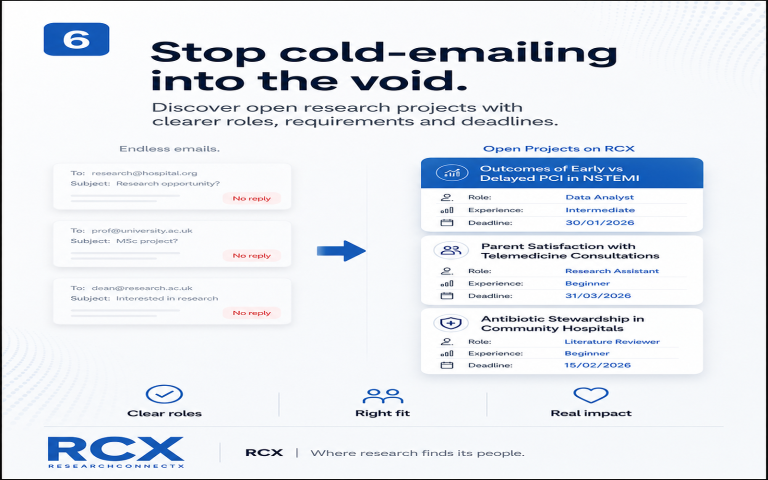
This creates a familiar mismatch: researchers struggle to find collaborators while capable contributors struggle to find projects.
The problem becomes even more pronounced in multidisciplinary research, where the best collaborator may not use the same terminology or work in the same specialty.
Why manual keyword searching has limits
Keyword searches are valuable, but they depend heavily on knowing the right words in advance.
Suppose a plastic surgery researcher wants to study recovery after peripheral nerve injury. Searching only for “plastic surgery nerve recovery” may miss a physiotherapist studying hand function, a neuroscientist analysing regeneration, a statistician experienced in longitudinal outcomes or a patient-reported-outcomes researcher using different terminology.
A good collaboration is often based on complementary expertise rather than identical keywords. AI-assisted matching can help highlight these relationships, provided that the underlying information is relevant and accurate.
Matching researchers by research interests
Shared research interests are an obvious starting point. A researcher working in reconstructive surgery may be interested in tissue engineering, nerve repair, surgical education or functional recovery.
An AI-assisted system can help organise these interests and compare them with other profiles or active projects. This is more useful when researchers can review and update their own profiles, ensuring that recommendations reflect current goals rather than outdated assumptions.
Interest matching can also reveal connections across disciplines. A data scientist interested in wearable sensors and a hand surgeon interested in functional rehabilitation may have an unexpectedly strong basis for collaboration.
Matching researchers by methodology
The same research question can require very different methodological expertise.
A systematic review needs literature-searching, screening and synthesis skills. A multicentre observational study may need epidemiology, statistical modelling and site coordination. A qualitative project may require interviewing, thematic analysis and experience of patient involvement.
Matching people by methodology makes it easier to identify practical gaps in a team. A principal investigator does not simply need “another researcher”; they may need someone experienced in meta-analysis, questionnaire design, genomics or economic evaluation.
Matching researchers by publication history
Publication history can provide useful context about previous research topics, methods and academic experience. It may help identify whether someone has worked on similar clinical questions, relevant datasets or established research techniques.
However, publications should not be treated as a complete measure of suitability. Early-career researchers may have relevant skills but few published papers, while an experienced academic’s older publications may not reflect current interests or availability.
Responsible AI research matching uses publication history as one signal among several, not as an automatic ranking of personal worth or research potential.
Matching complementary skills
Some of the most productive research collaborations happen because people bring different strengths.
A clinician may understand the practical problem. A bioinformatician may know how to analyse the dataset. A medical student may have capacity for literature screening. A statistician may improve the analysis plan. A patient partner may identify outcomes that matter in real life.
An intelligent matching system can help connect these complementary contributions, making research teams more multidisciplinary and reducing reliance on chance introductions.
The aim is not to find people who all look the same on paper. It is to build a team with the combination of expertise needed to answer the question properly.
Recommending open research projects
Collaboration becomes more actionable when recommendations are connected to real opportunities.
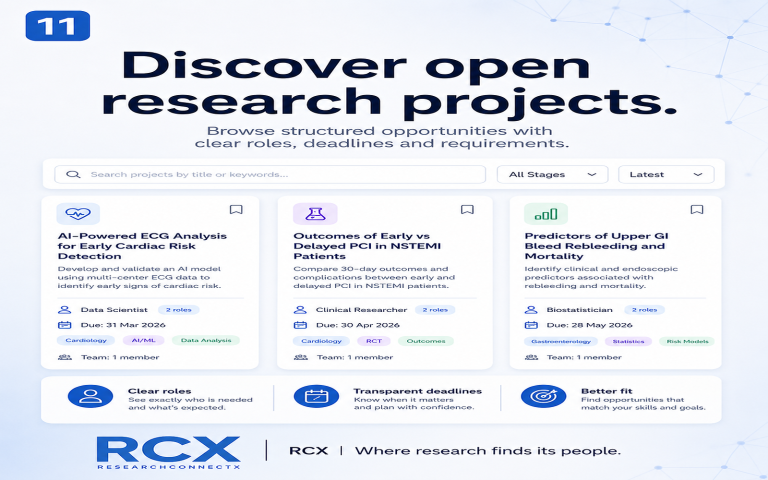
Instead of presenting only a list of potentially interesting researchers, an AI-powered platform can surface active projects that align with a user’s specialty interests, methodological experience or available skills.
For an early-career researcher, this can make it easier to identify a suitable first contribution. For a project lead, it can help relevant researchers find roles that might otherwise remain hidden within an existing network.
The quality of any recommendation still depends on clear project descriptions, realistic role requirements and human review of suitability.
Recommending conferences and dissemination opportunities
Research collaboration does not end when a team finishes its analysis. Projects need appropriate routes for presentation, feedback and publication.
AI-assisted recommendations can help researchers discover conferences and academic opportunities related to the themes of their work. A team studying surgical training, for example, may benefit from identifying relevant education meetings as well as specialty-specific conferences.
Suggestions should be checked against the event’s official website, submission dates, eligibility rules, costs and reputation. A recommendation is a starting point, not a guarantee that a conference is appropriate.
The risks and limitations of AI research matching
AI is only as useful as the information and assumptions behind it. Important limitations include:
- Incomplete profiles: Missing interests, skills or availability can distort recommendations.
- Outdated information: Previous publications may not reflect a researcher’s current focus.
- Visibility bias: Established researchers with larger publication histories may be easier to identify than talented newcomers.
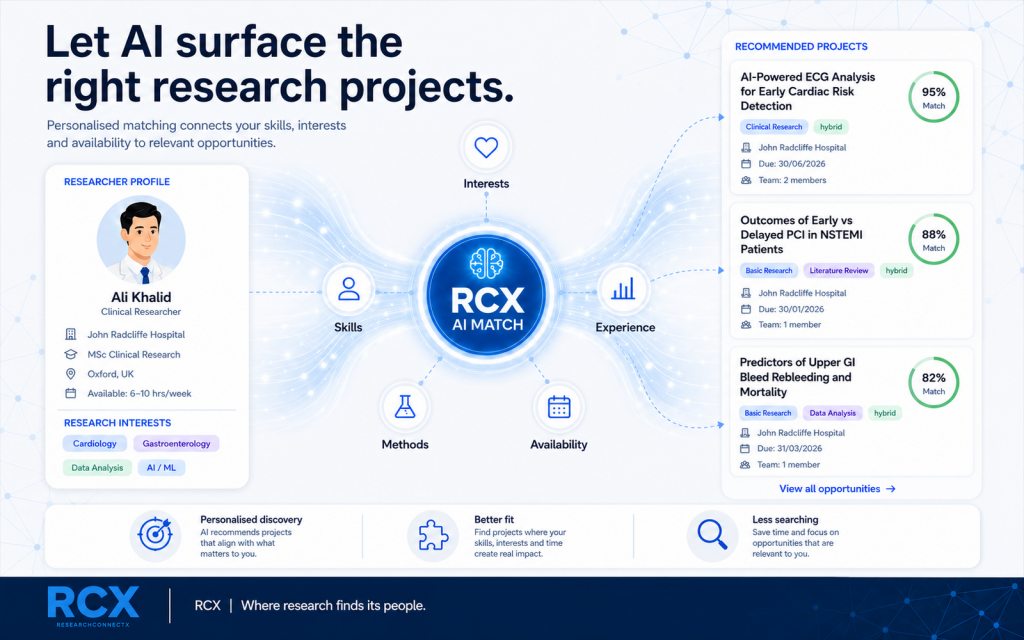
- False precision: A match percentage is an estimate, not proof that a collaboration will succeed.
- Privacy concerns: Researchers should understand what information is used and how it is processed.
- Context gaps: An algorithm may not understand interpersonal fit, supervision quality, institutional constraints or ethical considerations.
- Access and inclusion: Recommendations should not become another mechanism for reinforcing existing academic networks or excluding less visible researchers.
These limitations are reasons to design matching carefully, not reasons to avoid innovation altogether.
Why user control and transparency matter
Researchers should be able to understand the general basis of recommendations, review the information associated with their profiles and decide whether to pursue a suggested match.
An AI tool should support choice rather than make consequential decisions on the user’s behalf. Clear privacy information, editable profiles and visible project requirements help researchers retain control over their professional identities and collaborations.
RCX’s researcher privacy information explains that profile summaries and research-topic tags can be reviewed, edited or deleted, and that matching generates suggestions rather than solely automated consequential decisions.
This distinction matters: intelligent discovery should widen opportunities while leaving professional judgement with the people involved.
How RCX approaches AI research collaboration
ResearchConnectX is built around the idea that research collaboration should be easier to discover, initiate and manage.
Its AI-assisted matching considers research interests, methods, publications and practical skills to surface relevant researchers, open projects and academic opportunities. The wider platform connects those recommendations with project workspaces, collaboration tools and conference discovery.
Rather than treating AI as a standalone writing assistant, RCX applies it to the research journey:
- Discover relevant people and active research opportunities.
- Match researchers with complementary expertise and project needs.
- Collaborate through clearer connections and defined project roles.
- Manage tasks, milestones and team progress in a research-specific workspace.
- Share work through relevant conferences and dissemination opportunities.
The value is not that an algorithm can decide who belongs on a project. It is that the right people and opportunities become easier to find.
The future of AI tools for academics
The most useful AI tools for academics will not be those that simply produce more content. They will be the tools that reduce barriers, reveal relevant connections and help researchers spend their time on meaningful scientific work.
For students, that may mean seeing opportunities that were previously hidden. For clinicians, it may mean finding methodological expertise outside their hospital. For principal investigators, it may mean building stronger multidisciplinary teams with less reliance on informal networks.
Artificial intelligence cannot replace trust, supervision or scientific judgement. Used responsibly, it can make the first connection much easier.
Discover where research finds its people. Explore RCX or create your researcher profile.
Related reading: How smart-matchmaking supports research collaboration and how AI can help researchers identify suitable journals.
Frequently asked questions
What is AI research collaboration?
AI research collaboration uses intelligent matching and discovery tools to help researchers identify relevant collaborators, active projects, complementary skills and academic dissemination opportunities.
How can AI help researchers find collaborators?
AI can compare information such as research interests, methodologies, publication history and practical skills to surface people or projects that may be relevant. Researchers should still assess suitability themselves.
Are AI research-match scores a guarantee of quality?
No. Match scores are recommendations based on available information. They do not confirm a person’s availability, research integrity, interpersonal fit, institutional approval or future project success.