A research project rarely stalls because nobody had a good idea. It stalls because the protocol is in one email thread, the data-extraction sheet is somewhere in a shared drive, deadlines live in a WhatsApp message and nobody is sure who was meant to contact the statistician.
If you are asking how to manage a research team, the answer begins with a simple principle: every important part of the project should have a clear owner, an agreed next step and a place where the whole team can find it.
Strong research project management does not require corporate bureaucracy. It requires enough structure to help good researchers do good work without spending their time chasing updates.
The fragmented research-team problem
Most academic teams build their workflows gradually. A project starts in an email, moves into a group chat, acquires a spreadsheet and eventually develops several competing manuscript versions.
Each individual tool may be useful. The problem appears when nobody can answer basic questions quickly:
- What are we trying to deliver?
- Who is responsible for each task?
- Which deadlines matter next?
- Where is the current protocol or approved manuscript version?
- What decisions have already been made?
- Is anyone blocked or falling behind?
When those answers are scattered, project leads become human search engines and collaborators spend more time locating information than moving the research forward.
Define the project before defining the software
Every research team needs a short shared project overview. It does not have to be complicated, but it should explain the research question, intended output, current stage, key contributors, broad timeline and relevant governance requirements.
For example:
Project: Multicentre review of functional outcomes after complex hand trauma. Intended output: conference abstract followed by manuscript. Current stage: protocol refinement. Immediate milestone: agree eligibility criteria and complete the search strategy.
A clear overview gives new contributors context and makes it easier to identify the skills the team still needs.
Define roles and responsibilities
Research teams work better when roles are explicit. Depending on the study, these may include a principal investigator, project lead, literature reviewers, data collectors, a statistician, clinical supervisors and manuscript contributors.
One person can hold more than one role. What matters is that responsibilities are understood and that contributors know where to escalate questions.
Clarify:
- Who has overall scientific and governance oversight?
- Who coordinates day-to-day delivery?
- Who approves changes to the protocol or methodology?
- Who is responsible for each workstream?
- Who communicates with external sites or collaborators?
This reduces duplication and prevents important tasks from being assumed rather than assigned.
Define milestones that mean something
A milestone should represent a real stage of the project, not a vague ambition such as “make progress”.
Useful research milestones may include protocol approval, completion of the search strategy, screening, data extraction, analysis, first manuscript draft, abstract submission and final journal submission.
Set dates that reflect clinical commitments, academic deadlines and the availability of key contributors. A timeline is useful only if the team believes it is achievable.
Assign task ownership
The fastest way for a task to disappear is to make it everybody’s responsibility.
Each task should have:
- One named accountable owner.
- A clear description of what completion looks like.
- An agreed due date.
- Any dependencies or required approvals.
- A place to record progress or questions.
“Review the literature” is too broad. “Screen the first 150 titles against the agreed eligibility criteria by Friday” gives a collaborator something concrete to complete.
Shared responsibility is still important, but accountability works best when the next action belongs to a specific person.
Track deadlines and dependencies
Research deadlines are not limited to journal submissions. Teams may need to plan around ethics applications, conference abstract deadlines, funding calls, rotation changes, data-access approvals and supervisor availability.
Identify dependencies early. Statistical analysis cannot begin until the dataset is cleaned. A conference abstract cannot be finalised until outcomes are agreed. A multicentre study may need local approvals before individual sites can contribute.
Make the next deadline visible and explain what needs to happen before it.
Centralise project communication
Messaging apps can be useful for quick questions, but they are a poor permanent home for important project decisions. Information becomes difficult to retrieve, new team members lack context and discussions easily drift away from the task they relate to.
A better system links communication to the project itself. Keep decisions, updates and action points accessible to the people who need them, while continuing to follow institutional information-governance requirements.
For clinical research, never assume that a general messaging app or collaboration platform is appropriate for identifiable patient data. Sensitive information should remain within approved institutional systems.
Record decisions, changes and failed approaches
Good research management includes documenting what did not work.
If the team changes an eligibility criterion, excludes a planned outcome, abandons a recruitment strategy or revises the analysis plan, record what changed and why. This helps prevent repeated discussions, supports methodological transparency and makes manuscript drafting easier later.
A brief decision log can include the date, decision, rationale, person responsible and any follow-up action. The goal is not to create unnecessary paperwork; it is to preserve the reasoning behind important choices.
Agree authorship expectations early
Few issues damage research teams faster than unclear expectations about credit.
Discuss likely contributions, supervision and authorship principles at the beginning of the project. The ICMJE authorship recommendations explain that authorship depends on substantive contribution, participation in drafting or critical revision, final approval and accountability.
Make clear that authorship is not awarded for simply joining a messaging group, holding a senior title or performing a task without meeting the other relevant criteria. Equally, contributors should be given a fair opportunity to participate in the stages required for legitimate authorship.
Revisit authorship discussions when roles or contributions change.
Manage files and versions properly
Every team should know where to find the current protocol, approved data-collection materials, analysis plan and latest manuscript draft.
Agree basic naming conventions and avoid files called “Final”, “Final_v2” and “Final_ACTUAL_FINAL”. Identify who owns the master version and how changes will be reviewed.
Use institutionally approved storage for sensitive research information. A collaboration workspace can help organise links, responsibilities and progress, but it does not remove the need to follow local data-protection and governance policies.
Create a realistic progress-review cadence
Most research teams do not need daily meetings. They do need a predictable rhythm for identifying progress and obstacles.
A brief weekly or fortnightly review can cover:
- What was completed since the previous update?
- What needs to happen next?
- Which tasks are overdue or blocked?
- Are upcoming deadlines still realistic?
- Has anything changed in the methodology, team or governance requirements?
For busy clinical teams, an asynchronous written update may work better than repeatedly trying to coordinate a meeting across different rotas.
Adoption is harder than choosing the software
The best research team management software is not the platform with the longest feature list. It is the one that contributors actually use.
Researchers are more likely to adopt a system when it reduces work, is easy to understand and makes the next action obvious. Introduce one clear project overview, one agreed task list and one consistent update process before adding more complexity.
Avoid maintaining duplicate records across several platforms. If an important task is tracked in three places, nobody can be certain which version is current.
Why a research-specific project workspace helps
General project-management tools can organise tasks, but they are not always built around the realities of academic collaboration: changing teams, cross-institution work, research-specific roles, authorship expectations and dissemination opportunities.
A research-specific workspace can connect the team that was recruited with the project it is delivering. This makes it easier to move from finding collaborators to managing their contributions, tracking progress and identifying opportunities to present or publish.
How RCX project workspaces fit
ResearchConnectX brings project organisation into the same environment used to discover researchers and open research opportunities.
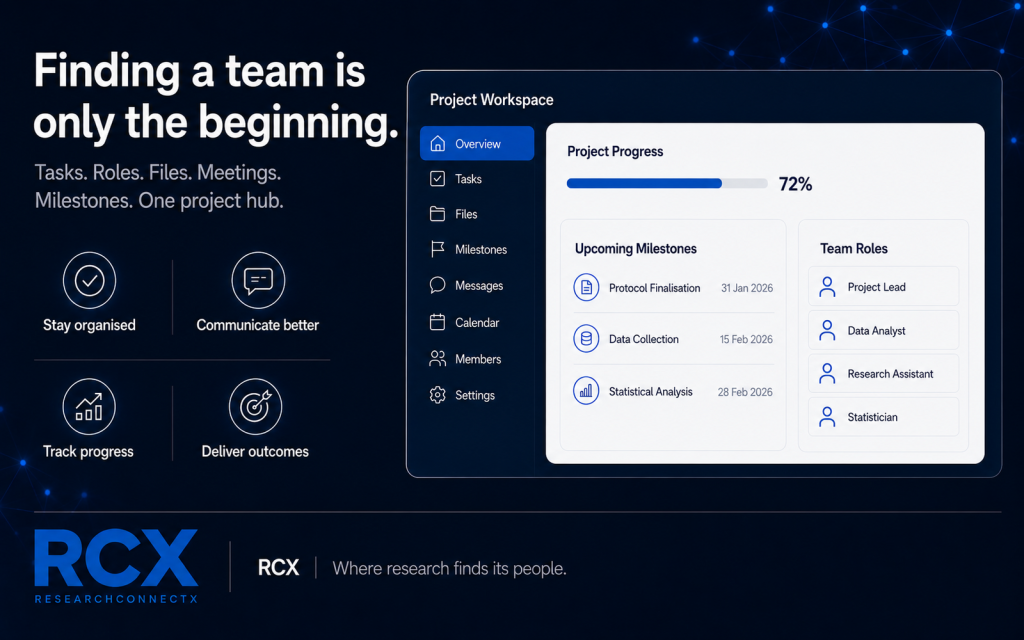
Its project workspaces are designed around:
- Clear tasks and named owners.
- Due dates and project milestones.
- Shared project files and relevant documentation.
- Team roles and collaboration visibility.
- Research communication and progress tracking.
- The wider pathway from collaboration to presentation or publication.
RCX is not a substitute for ethical approval, institutional oversight or compliant clinical-data infrastructure. Its role is to help researchers coordinate the people, tasks and decisions that move a project forward.
A simple framework for research project management
Start with five questions:
- Purpose: What are we trying to deliver?
- People: Who is responsible for each part?
- Plan: What are the next milestones and deadlines?
- Progress: How will the team track completion and obstacles?
- Principles: How will we handle communication, governance and authorship?
If every contributor can answer those questions, the project is already better organised than many research teams.
Build a research team that stays aligned. Explore RCX project workspaces or create your account.
Related reading: How RCX simplifies research project management and why senior researchers struggle with fragmented collaboration.
Frequently asked questions
What is the best way to manage a research team?
Create a shared project overview, define roles, assign named task owners, agree milestones, centralise important decisions and review progress at a realistic interval.
What should research project management software include?
Useful features include clear responsibilities, visible deadlines, task tracking, project milestones, accessible communication, document organisation and a workflow that the whole team can adopt.
How should research teams handle authorship?
Discuss authorship expectations early, assess contributions transparently and apply the journal’s requirements or recognised standards such as the ICMJE authorship criteria.