Finding an academic conference is easy. Finding the right conference – one that reaches the audience your work needs, accepts the type of submission you have and gives you enough time to prepare – is much harder.
Researchers often search too narrowly, discover meetings after the abstract deadline, or choose an event because its title sounds relevant without checking the programme, organisers or audience. A better approach is to treat conference discovery as a structured part of the research workflow rather than a last-minute search after the analysis is complete.
The practical answer: define what you want from the conference, search by topic and method as well as specialty, build a scored shortlist, verify legitimacy, and place every abstract, funding, registration and travel deadline into one calendar.
Why choosing the right conference matters
A conference is not simply a place to display a poster. The right meeting can help you:
- receive feedback before journal submission;
- meet researchers using similar methods or datasets;
- identify potential collaborators, supervisors or funders;
- understand where your field is moving;
- build visibility within a relevant specialist community;
- convert a completed project into a presentation and, eventually, a publication.
The biggest or most famous meeting is not automatically the best choice. A focused specialty conference may place your work in front of a more relevant audience than a large general event. Conversely, a broad interdisciplinary meeting may be more valuable when the main contribution is methodological or crosses traditional specialty boundaries.
Start by deciding what you want from the conference
Before opening a conference database, write down the purpose of presenting. Your search will be much more precise when the desired outcome is clear.
Common goals include:
- Early feedback: you have preliminary findings and want expert criticism before final analysis or manuscript submission.
- Specialist visibility: you want researchers in a precise field to see the work.
- Collaboration: you need a methodologist, statistician, clinical partner or international site.
- Publication pathway: the conference publishes abstracts or proceedings that matter in your field.
- Career development: you want workshops, mentoring, networking or training opportunities.
- Institutional impact: the project needs exposure to healthcare leaders, policy makers, industry or funders.
A conference that is excellent for networking may be poor for detailed methodological feedback. A meeting that offers a prestigious oral presentation may be unaffordable or occur before your data are mature. Define the priority before comparing options.
Search by topic, method and population – not specialty alone
Searching only for “cardiology conferences” or “AI conferences” produces a large, noisy list. Break the project into three layers:
- Field or specialty: cardiology, ophthalmology, education, public health, engineering.
- Specific topic or population: inherited retinal disease, surgical training, adolescent mental health, health inequalities.
- Method or research type: randomised trial, qualitative study, systematic review, machine learning, implementation science.
Then combine those layers in searches such as:
- “ophthalmology inherited retinal disease conference abstract”;
- “medical education qualitative research conference”;
- “AI clinical prediction conference call for abstracts”;
- “implementation science healthcare conference Europe”.
This approach finds meetings that may sit outside your formal specialty but are highly relevant to the actual contribution of the project.
Six reliable ways to find academic conferences
1. Professional societies
Start with the recognised professional societies in your field. Their annual meetings, special-interest groups and regional events are usually clearly documented, and their websites often contain abstract guidance, previous programmes and educational tracks.
Do not stop at the largest society. Subspecialty organisations, trainee groups and methodological societies can be more closely aligned with your work.
2. Recent papers and active research groups
Look at the authors publishing the work most similar to yours. University profiles, laboratory pages and professional biographies often show where they present. Recent conference abstracts in your reference list can also reveal recurring meetings that matter to the field.
The objective is not to copy another team’s dissemination plan. It is to identify where the relevant scientific community already gathers.
3. Journals, funders and research networks
Journals sometimes advertise associated meetings, calls for symposia or conference supplements. Funders, clinical research networks, learned academies and university research centres may also list events relevant to their communities.
These routes are particularly useful for interdisciplinary work that does not fit neatly within one specialty society.
4. University and institutional calendars
Departments, doctoral training programmes, biomedical research centres and research offices often circulate seminars, local research days and external conference opportunities. Smaller events can be valuable for an early presentation, especially when travel funding is limited or the project needs feedback before a major submission.
5. Conference databases, alerts and saved searches
Conference directories can widen discovery, but they should be treated as starting points rather than automatic endorsements. Create saved searches for your field, topic and methods, and review them at a regular interval.
Google Alerts and society mailing lists can help, but they still require manual filtering. A long list of events is not useful if no one assesses relevance or records the deadlines.
6. Personalised recommendation tools
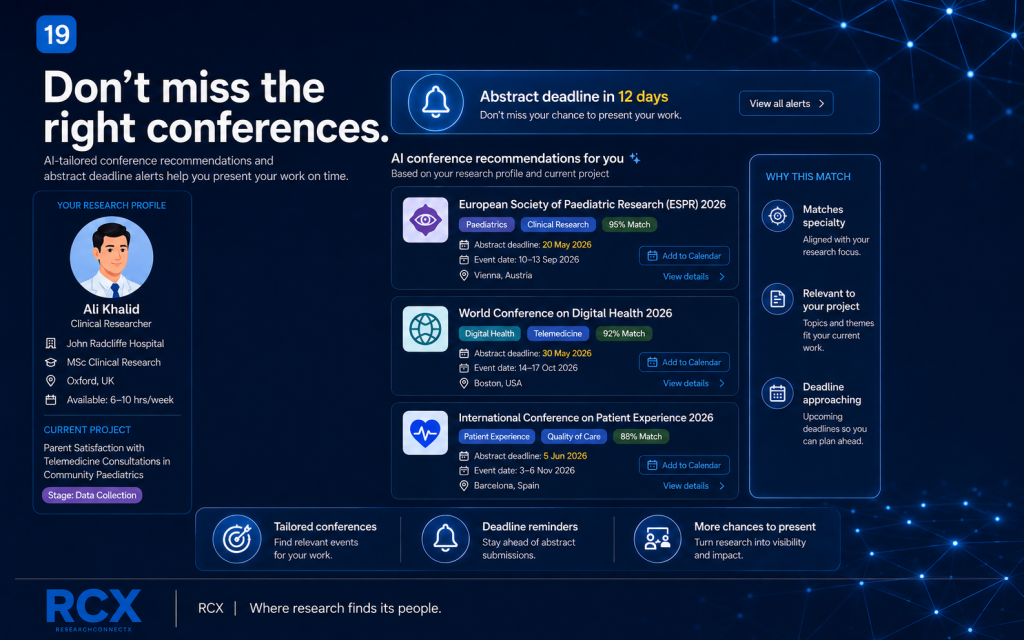
Recommendation systems can reduce the manual work by comparing conference topics with a researcher’s profile, publications, interests or active projects. RCX Conference Radar is designed around this problem:
relevant meetings and presentation opportunities can be surfaced around the research already being undertaken, rather than requiring the researcher to repeatedly start from a blank search box.
Recommendations should still be reviewed by the researcher. An algorithm can improve discovery, but it cannot decide whether the scientific audience, cost, timing and reputation are right for a particular career or project.
Build a conference shortlist instead of choosing the first result
Create a simple comparison sheet for every plausible meeting. Include:
- conference name and organiser;
- topic and target audience;
- location and format;
- abstract deadline;
- conference date;
- accepted presentation types;
- word or character limit;
- whether preliminary work is accepted;
- registration and travel cost;
- travel-grant deadline;
- expected publication of abstracts or proceedings;
- credibility checks;
- the specific reason this conference fits your project.
A basic score can help. Rate each conference for scientific relevance, audience fit, timing, credibility, cost and likely value. The score does not replace judgement; it prevents one attractive feature from hiding several practical problems.
How to check whether a conference is legitimate
Researchers should assess conference legitimacy before submitting an abstract, paying fees or booking travel. The Think. Check. Attend. initiative provides a useful checklist for this purpose.
Look for evidence that:
- the organiser is identifiable and has a credible track record;
- previous editions of the conference can be verified;
- the scientific or programme committee contains real researchers whose involvement can be confirmed;
- the scope is coherent rather than covering an implausibly broad collection of unrelated disciplines;
- the venue, dates and contact details are clear;
- fees, refund terms and submission processes are transparent;
- keynote speakers are confirmed rather than merely “invited” without permission;
- the peer-review or abstract-selection process is explained;
- the website contains a realistic programme and information from previous meetings.
Warning signs include aggressive unsolicited invitations, guaranteed acceptance, pressure to pay immediately, unclear organisers, copied branding, constantly changing locations, and promises that are disproportionate to the scientific process.
No single warning sign proves that an event is fraudulent. The problem is the overall pattern. When uncertain, ask a supervisor, society, institutional research office or experienced colleague before committing funds.
Never miss an abstract deadline again
The abstract deadline is only one of several dates that matter. For each shortlisted conference, record:
- standard abstract deadline;
- late-breaking abstract deadline, if applicable;
- internal supervisor or co-author review deadline;
- travel-grant or bursary deadline;
- early-bird registration deadline;
- presenter-registration deadline;
- visa-support deadline;
- final poster or slide upload deadline;
- conference date;
- manuscript or proceedings deadline, where relevant.
Then work backwards. An abstract should not first reach co-authors on the evening it is due. Build time for data checks, approval of authorship and wording, institutional sign-off where required, and technical problems with the submission portal.
A useful rule is to create three calendar reminders: one when the opportunity is identified, one when the internal draft must be ready, and one well before the external deadline. The internal deadline is the important one; the external deadline should be the final safety margin.
Match the conference to the maturity of the research
Not every project is ready for the same type of submission.
- Idea or protocol stage: consider workshops, methods meetings, doctoral forums or protocol-focused events.
- Early data: look for meetings that accept work in progress or preliminary findings.
- Completed analysis: target specialty meetings where the findings can receive focused scientific feedback.
- Manuscript in preparation: choose an audience that can sharpen interpretation before journal submission.
- Published work: consider invited talks, implementation meetings or wider interdisciplinary dissemination.
Read the call for abstracts carefully. Do not imply that results are complete if they are not, and do not submit the same work in a way that conflicts with conference or journal policies.
How RCX Conference Radar fits into the workflow
Conference discovery is most useful when it is connected to the research itself. RCX brings researcher profiles, active projects, collaboration and dissemination into one environment. Its Conference Radar can surface meetings and presentation opportunities aligned with the user’s topic and current work, while deadline visibility helps teams plan submissions earlier.
That does not remove the need to evaluate legitimacy, read the full call for abstracts or obtain co-author approval. RCX should function as the discovery and coordination layer, while researchers retain control of the scientific and professional decision.
Conference planning checklist
Before submitting, confirm that:
- the audience is relevant to the project;
- the event is credible and independently verifiable;
- the abstract fits the stated scope and format;
- all authors have reviewed and approved the submission;
- authorship order and presenter responsibility are agreed;
- the data and claims are accurate;
- funding and travel are realistic;
- every internal and external deadline is recorded;
- the team knows what will happen if the abstract is accepted;
- the conference plan supports the wider publication strategy.
Frequently asked questions
How do I find conferences in my research area?
Search through professional societies, recent papers, active research groups, funders, university calendars and reputable conference directories. Use combinations of your specialty, specific topic and methodology rather than one broad field term.
How early should I look for a conference?
Start while the project is active, not after the manuscript is finished. Many conferences publish dates and calls months in advance, and travel funding or early-bird deadlines may close before the final registration date.
How can I tell whether a conference is predatory?
Verify the organiser, previous events, scientific committee, programme, venue, fees and review process. Use the Think. Check. Attend. checklist and seek institutional advice when the evidence is unclear.
Can I submit preliminary results?
Sometimes. The call for abstracts should state whether work in progress, protocols or preliminary findings are accepted. Describe the status honestly and avoid claiming analyses that have not been completed.
What should I do if I discover a relevant conference after the deadline?
Check whether there is a late-breaking call, workshop, satellite meeting or future edition. Add the event to a recurring calendar so the next deadline is identified earlier, and consider a different credible meeting that fits the current project timeline.